

Register to continue reading for free
Retail Flash: Footwear trails broader retail across key markets

The retail landscape in the Netherlands, France, Spain, Germany, the UK, the US and Japan remains uneven, with the footwear sector often trailing behind broader retail and fashion categories. Fragile consumer confidence, varying pricing power and cautious inventory management continue to weigh on the sector, while stronger digital sales have yet to translate into a broader footwear recovery
Footwear Lags the Broader Retail Market
Footwear continues to underperform against the broader retail sector in several major markets. In France, for example, footwear sales fell by 5.9% in March and 4.4% in April 2026, while total retail sales remained close to stagnation and online sales continued to grow. In Germany, footwear and leather goods sales fell by an even sharper 11.6% in April.The Netherlands followed a similar pattern. Despite retail turnover remaining positive, footwear turnover fell by 2.0% in March and 3.6% in April, having increased by 7.2% in January and 5.9% in February 2026. This suggests renewed weakness in the footwear sector rather than a general deterioration in the Dutch retail sector.
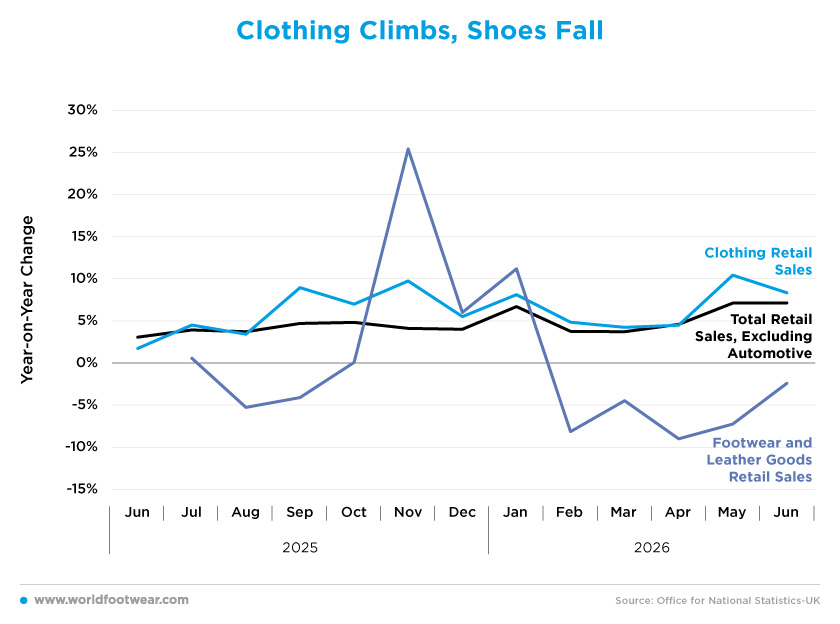
This same divergence is particularly visible in the UK (see the graphic below). Total retail sales increased by 7.0% year-on-year in both May and June, while clothing sales grew by 10.3% and 8.2% respectively. However, footwear and leather goods remained in contraction throughout June, suggesting category-specific weakness rather than a general deterioration in retail demand.
A similar, albeit less severe, pattern is evident in the US. Following strong growth at the beginning of 2026, footwear sales lost momentum, rising by just 2.2% in June compared to 5.3% for clothing and accessories.
In contrast, Spain saw a more positive trend, with fashion sales rising by 5.7% year-on-year in May. However, higher prices and weaker consumer confidence suggest that the improvement in turnover was not necessarily matched by an equally strong recovery in sales volumes. The recovery in Japan was also uneven: apparel and accessories (including footwear) sales grew by just 0.6% in June, compared with a 12.1% increase in textiles.
Pricing Power Varies
France, the UK and the Netherlands (see graphic below) showed the clearest signs of limited footwear pricing power. In France, footwear inflation stood at just 0.2% in May, despite headline inflation reaching 2.8%. Meanwhile, footwear prices in the UK remained deflationary despite positive broader inflation. The divergence was even more pronounced in the Netherlands, where footwear prices fell by 2.9% in May while headline inflation was at 3.4%.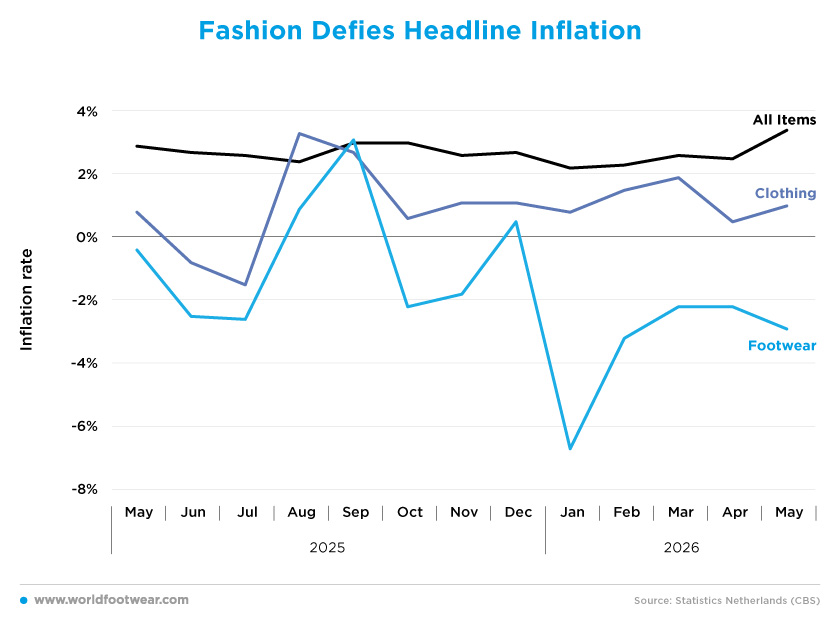
Meanwhile, Germany moved in the opposite direction, with footwear inflation accelerating to 2.2% in June despite weak sales. Spain also moved away from earlier deflation, with footwear inflation reaching 3.1% in April, before easing to 2.4% the following month.
Similar tensions emerged in the US, where footwear prices were rising faster than headline inflation, while retail sales failed to accelerate at the same pace. By contrast, Japan saw footwear inflation recover to 1.6% in July, though this remained below clothing and headline inflation.
Consumer Confidence Remains Fragile
Although the relationship between confidence and retail performance differs by market, weak household sentiment remains a common constraint.Germany experienced one of the sharpest deteriorations (see graphic below), with consumer confidence falling to -17.6 in April, while footwear sales contracted by 11.6%. France has also seen persistently negative confidence alongside weak footwear demand.
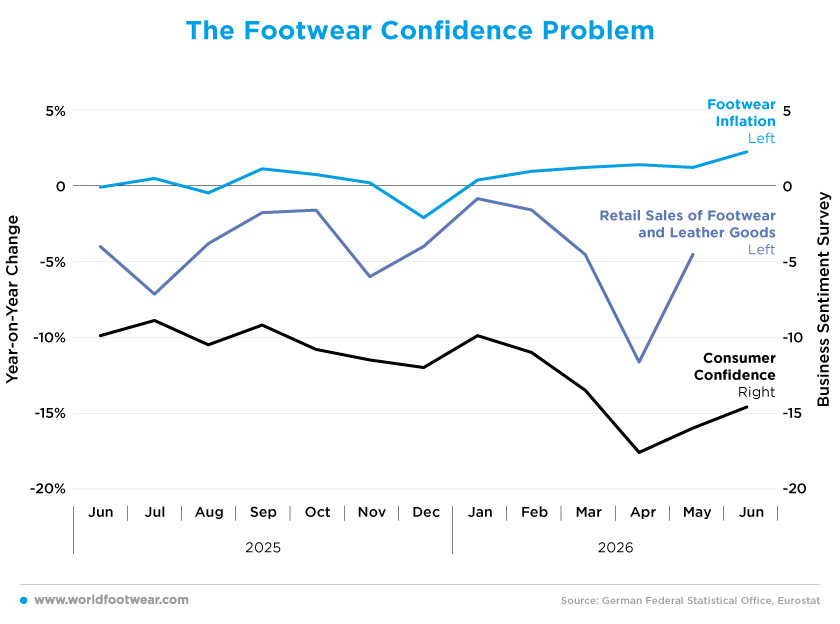
The Netherlands case is notable for the fact that consumer and retailer sentiment moved in opposite directions. While consumer confidence fell to -22.0 in May, retail confidence rebounded to 9.7, highlighting a substantial gap between household caution and business expectations.
Spain also recorded weaker confidence despite improving fashion sales, raising questions about the strength of underlying demand. In Japan, consumer confidence recovered to 35.5 by August, having fallen sharply in spring, though remaining below its February peak of 39.7.
Digital Growth Outpaces Physical Retail
Where comparable data are available, digital channels remain an important source of growth. For example, in France (see grpahic below), online retail sales increased by 5.7% in April, while total retail sales contracted slightly and footwear sales fell by 4.4%.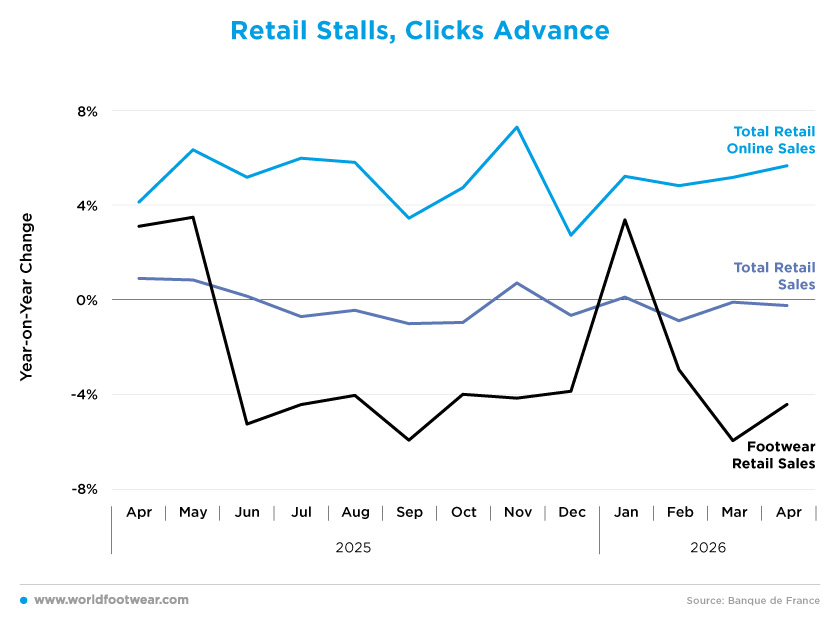
The disparity is considerably wider in the UK. Despite physical footwear and leather goods sales remaining in contraction, online textile, clothing and footwear sales grew by around 30% to 31% in spring 2026. In the US, the shift is more gradual: e-commerce accounted for 16.8% of clothing and general merchandise sales in the second quarter of 2026, which is slightly above the 16.4% share for total retail.
Overall, digital growth is providing resilience, but it has not been sufficient to offset the weakness of the footwear sector across all markets.
Retailers Take a More Cautious Approach to Stock
In early 2026, footwear imports weakened substantially across several markets, suggesting greater caution regarding inventory. Germany recorded one of the steepest declines (see graphic below), with footwear import values falling by 18.3% year on year in April, while Spain saw a 17.1% decrease in the same month.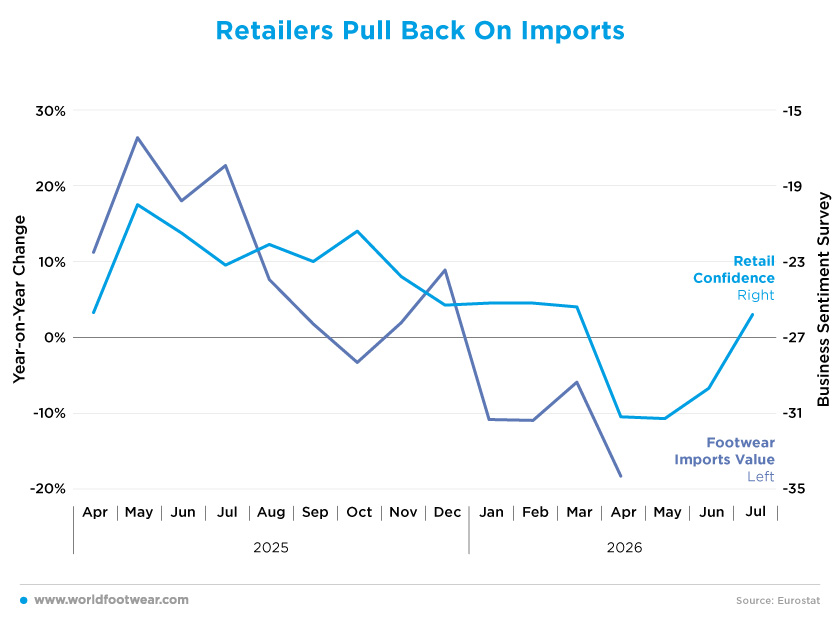
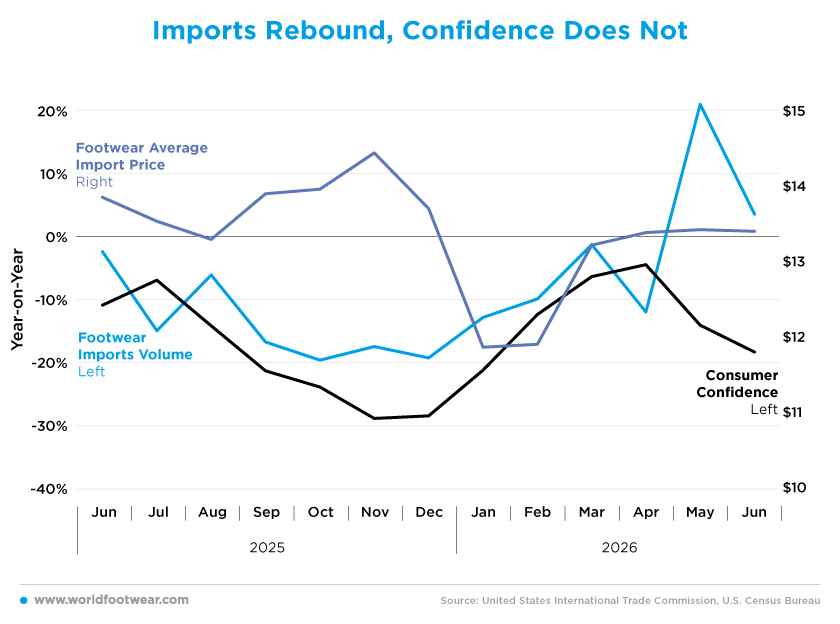
The US exhibited a similar trend (see graphic below), with footwear import volumes dropping by 12.1% in April, following double-digit decreases in January and February. France also recorded weaker imports, although its latest figure, for March, shows a 5.5% fall in imports, an improvement of on the declines of 10.0% in January and February.
The UK had already shown signs of pulling back on imports in late 2025, with footwear imports falling by 8.8% in October and by 14.3% in November, which may have reflected reduced replenishment as retailers worked through existing stock.
In contrast, the Netherlands has shown comparatively resilient footwear imports throughout February 2026. However, the available data predate the sharp deterioration in Dutch consumer confidence during spring 2026, so the subsequent direction is unclear.
Japan presents a different pattern, with declining or weaker volumes being accompanied by more resilient values. This suggests higher average import prices, making Japan less directly comparable with import growth trends in other markets.
Overall, the available data indicate greater inventory caution in several major footwear markets, particularly in Germany, Spain, the US and France. However, differences in reporting periods and measures mean that import trends should not be interpreted as fully comparable across all seven countries.