
Register to continue reading for free
Spain Retail: Fashion recovers amid mixed market signs

Spanish retail has remained resilient over the past year, supported by sustained growth in online sales. Meanwhile, the fashion sector recovered in early 2026 following a weaker performance in 2025. However, rising prices, weakening consumer and retail confidence, and lower footwear imports suggest that the improvement in turnover this year reflects a mixed market environment rather than an overall strengthening in demand
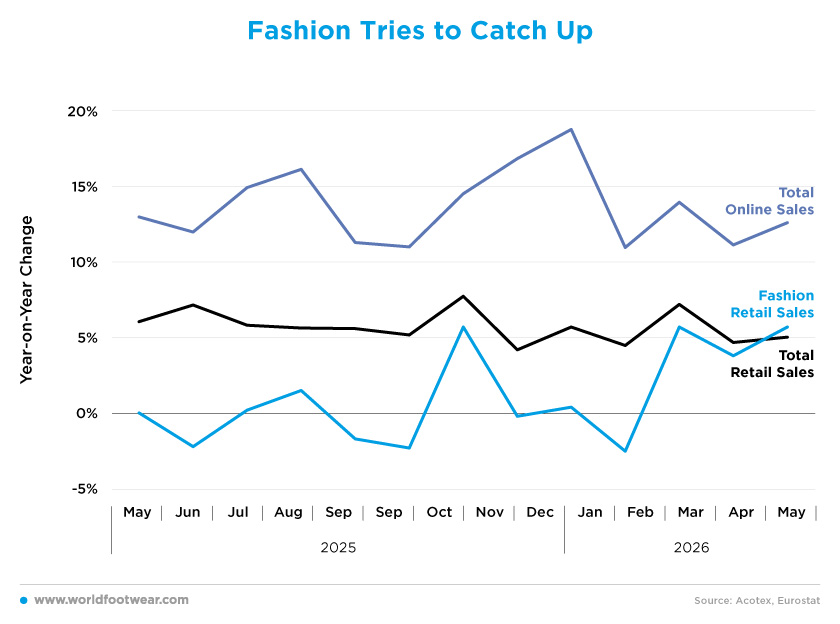
Fashion Tries to Catch Up
Spanish retail sales remained firmly positive throughout the analysed period, with total retail trade continuing to grow at a solid pace. Year-on-year growth remained above 4% in every month, rising from 6.1% in May 2025 to 7.2% in June, before moderating slightly throughout the summer and autumn months. Total retail sales strengthened again in early 2026 after reaching 4.2% in December, growing by 7.2% in March and 5.0% in May.Fashion retail sales followed a much more uneven path. In 2025, growth was weak or negative in several months, including June (-2.2%), September (-1.7%) and October (-2.3%). However, the sector improved from November onwards, showing a clearer recovery in spring 2026. Following a 2.5% fall in February, fashion sales rebounded with increases of 5.7%, 3.8% and 5.7% in March, April and May respectively.
The improvement in fashion sales has bolstered optimism ahead of the summer sales season, with sector representatives forecasting growth of between 3% and 6% for clothing and footwear. However, they also warn that a higher turnover does not necessarily equate to greater profitability, as labour costs and absenteeism continue to put pressure on margins (modaes.com).
Online retail continued to outperform the wider market. Growth remained in double digits throughout the period, ranging from 18.7% in January to 10.9% in February 2026. Even when total retail growth slowed, online sales remained strong, increasing by 13.9% in March, 11.1% in April and 12.6% in May.
This digital strength is also evident in the footwear industry. Online footwear retail in Spain now attracts 7.6 million annual shoppers, equivalent to 39% of Spanish internet users. Purchases of footwear online are driven by price, variety and convenience, while physical stores remain important for trying on products and checking their comfort. This shows that the sector is increasingly shaped by a division of roles between digital and physical channels (revistadelcalzado.com).
Inflation Spreads to Fashion
Inflation in Spain increased steadily over the period analysed. All-items inflation stood at 2.0% in May 2025, remaining above 2% throughout the subsequent months and rising to 3.2% in both October and November. After easing slightly at the start of 2026, it accelerated again, reaching 3.4% in March, 3.5% in April and 3.6% in May.This acceleration occurred within a broader macroeconomic environment in which inflation risks had intensified. Spain’s inflation forecast for 2026 has recently been revised upwards, with higher energy prices linked to the war in the Middle East (reuters.com).
Fashion prices followed a very different path. From May 2025 to March 2026, the sector was mostly in negative territory, experiencing inflation ranging from -2.6% in January 2026 to 0.6% in December 2025. However, this changed sharply in the spring of 2026. Fashion inflation rose to 5.5% in April and remained high at 5.2% in May, surpassing headline inflation.
Although footwear prices were less volatile than those in the wider fashion category, they also increased in spring 2026. Having remained close to zero or negative for most of 2025 and early 2026, footwear inflation rose to 3.1% in April and 2.4% in May.
This marked a clear change from the earlier deflationary pattern, albeit an uneven one. Recent data indicates differences between categories, with stronger price increases observed in men’s footwear, while price increases were weaker in women’s and children’s footwear.
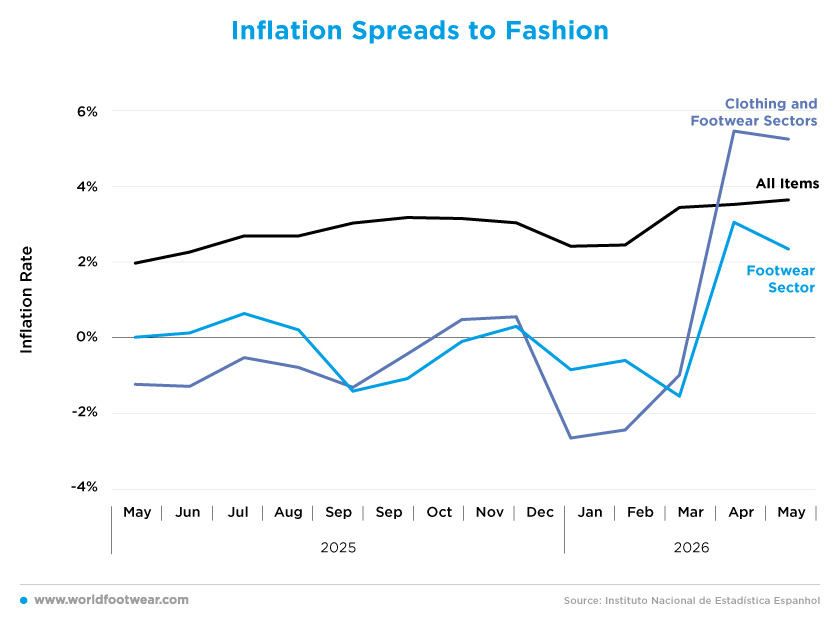
The spring increase in fashion and footwear prices should therefore be read with caution. While it suggests renewed pricing pressure after several months of weak or negative price growth, it does not necessarily indicate a healthier market. Sales remain volatile, footwear prices eased in May, and companies continue to face cost pressures that limit the benefits of higher turnover.
A Recovery Without Confidence
The previous sections revealed two concurrent trends in spring 2026: fashion sales increased by 5.7% year-on-year growth in March and May, and footwear inflation also turned positive, peaking at 3.1% in April. This graph adds a third element to the picture: consumer confidence weakened at the same time as sales and prices were improving.Consumer confidence remained negative throughout the analysed period. After improving between July and October 2025, when the indicator moved from -4.5 to -0.1, confidence weakened again. This decline became more pronounced in 2026, with confidence falling from -3.1 in March to -6.3 in April and -6.4 in May. Although there was a slightly improvement in June, to -5.3, this remained well below the levels recorded in late 2025.
This makes the recent improvement in fashion sales harder to interpret. The rebounds in March and May coincided with the return of positive footwear inflation and a sharp increase in fashion-sector prices. As a result, some of the improvements may be due to higher prices rather than a purely volume-driven recovery. Seasonal and calendar effects may also have played a role, particularly during the spring.
This interpretation is consistent with forecasts indicating a slowdown in clothing and footwear retail in 2026.
According to a forecast prepared by the National Association of Large Distribution Companies (Anged) and the Centre for Economic Forecasting (Ceprede), sales of clothing and footwear are expected to grow by just 0.8% in volume terms this year, compared to 5.6% in 2025. This is due to private consumption and retail trade losing momentum after a stronger previous year. The same outlook points to weaker household spending power, with higher mortgage costs expected to weigh on consumption trends (moades.com).
Earlier sector data also suggests that the recent growth figures should be interpreted with caution. The rebound in fashion sales in March was helped by the Easter calendar, following weak performances in the previous two years. Sector representatives also stressed that the market remains sensitive to external factors, including weather and geopolitical uncertainty (revistadelcalzado.com).
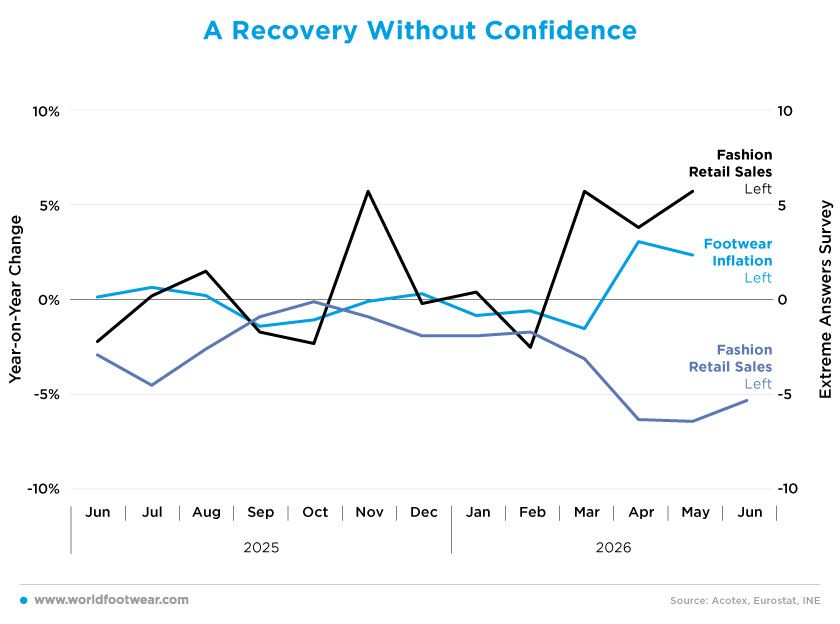
Therefore, the spring increase in value does not fully contradict the fall in confidence. Higher prices, seasonal effects and a weak comparison base may have boosted nominal sales, despite the deterioration in household sentiment. This suggests a recovery in turnover that is still fragile in terms of underlying demand.
Lower Confidence, Leaner Stock
Footwear imports into Spain lost momentum sharply at the start of 2026. While the series was volatile in 2025, it still included several strong months, with imports rising by 23.6% in June, 20.8% in July, and 11.7% in December. However, this changed in 2026. Imports fell by 9.5% in January, 10.6% in February, 7.8% in March and 17.1% in April. This marked a clear deterioration compared to the stronger figures recorded the previous year.Retail confidence followed a slower but consistent downward trend. The indicator stood at 141.9 in the second quarter of 2025 and rose to 144.7 in the third quarter, before easing to 142.8 in the final quarter. It then fell to 140.0 in the first quarter of 2026, dropping further to 137.7 in the second quarter. While this decline was less abrupt than the fall in imports, it signals a more cautious retail environment.
This weaker business mood is consistent with broader signs of stress in Spain’s footwear value chain. The leather and footwear industry remained in negative territory in May, with turnover falling for the tenth consecutive month (revistadelcalzado.com).
Industrial production data also points in the same direction. In May, production in the leather and footwear remained down year-on-year, and the cumulative decline for the first five months of the year remained significant. Consequently, the sector continued to lag behind the wider Spanish industrial economy, which recorded positive growth in the same month.
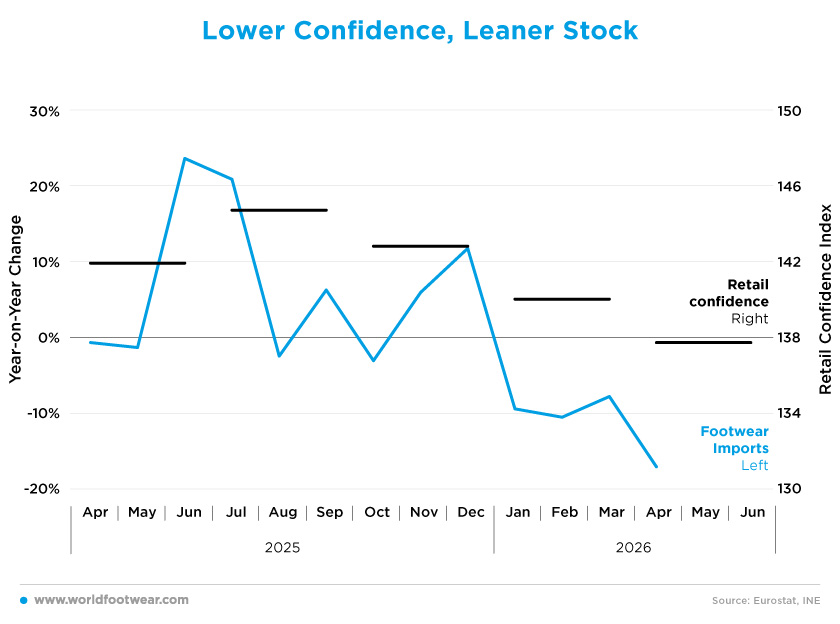
The fall in imports at the start of 2026 may therefore indicate a more cautious approach to stock management. Following a strong import growth in parts of 2025, weaker retail confidence, lower industrial turnover and fragile demand may have encouraged companies to minimise their exposure to excess inventory.