
Register to continue reading for free
UK Retail: Footwear market faces broad-based weakness

Although clothing sales remained resilient and online fashion retail continued to grow in the first half of the year, the footwear sector faced a more challenging environment characterised by ongoing price deflation, weak retail sales, and subdued household spending. A sharp contraction in footwear imports also suggests greater caution among retailers and distributors, suggesting that pressure has extended beyond consumer demand to inventory and replenishment decisions
Fashion Prices Remain Soft
UK inflation eased during the analysed period but remained clearly positive. All-items inflation stood above 4% between June and August 2025, before gradually declining through the second half of the year. It fell from 4.0% in September to 3.6% in November and December, then eased further to 3.2% in January and February 2026. Following a temporary rise to 3.5% in March, inflation slowed again, reaching 3.0% in April and May and 2.8% in June.The slowdown was aided by lower fuel prices after a brief easing of energy pressures, while food inflation also moderated. However, this improvement was fragile: the Bank of England still expects inflation to rise again in the third quarter, and renewed energy pressure scould push prices higher later in the year. As Yael Selfin, chief economist at KPMG, put it, “underlying inflationary pressures remaining relatively muted in an environment of weak domestic demand”, strengthening the case for caution rather than celebration (reuters.com).
The picture was very different in the footwear sector. Footwear prices kept contracting in every month during this period, ranging from -1.4% in May 2026 to -3.5% in March. Even when all-items inflation was above 4% in mid-2025, footwear prices were falling by around 2%. This suggests that footwear prices were moving against the broader inflationary environment rather than in line with it.
Clothing prices remained more stable but also subdued. Although modest, clothing inflation was mostly positive, reaching 1.7% in February 2026 and 1.1% in March and April. However, it also slipped into negative territory in November 2025, March 2026, and June 2026. Throughout the period, clothing-price growth remained limited compared with headline inflation.
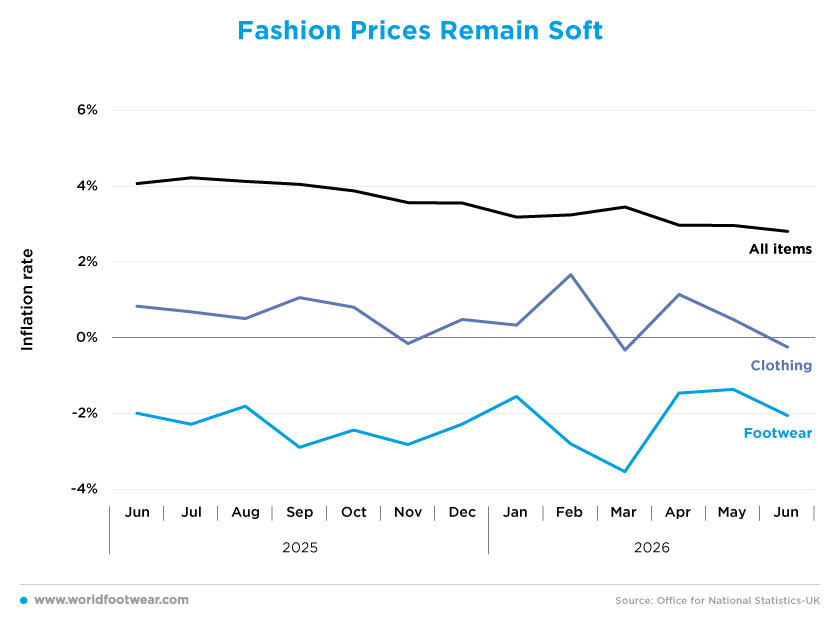
The UK retail market shows mixed signs of inflation. While overall prices remained high enough to weigh on household budgets, clothing and footwear did not behave as inflationary categories would be expected to. In the footwear sector, persistent deflation suggests a market in which retailers have limited pricing power and rely on discounts to maintain demand.
Clothing Climbs, Shoes Fall
UK retail sales, excluding automotive fuel, remained positive throughout the period analysed. Growth stood at 3.0% in June 2025, staying between 3.6% and 4.7% throughout the second half of the year, before accelerating to 6.6% in January 2026. Following a more moderate growth in February and March, total retail sales strengthened again, reaching 4.5% in April, and 7.0% in both May and June.Clothing retail sales were generally stronger than total retail sales. After rising by 1.7% in June 2025, clothing sales accelerated to 8.8% in September and 9.6% in November. Growth remained positive every month during this period, reaching 8.0% in January 2026, 10.3% in May, and 8.2% in June. This suggests that the clothing market was often outperforming the broader retail market.
Footwear and leather goods followed a much less stable path. Sales contracted in June, August and September 2025, before recovering sharply at the end of the year. November was particularly strong, with growth of 25.2%, followed by 5.9% in December and 11.1% in January 2026. However, this rebound then broke down, with sales returning to contraction in February and remaining negative through June.
The timing is notable, as the relapse coincided with the start of the Iran–US conflict, which created renewed pressure around living costs and future expectations. The effect of this uncertainty could still be seen later in the spring. Commenting on April’s retail figures, Harvir Dhillon, an Economist at the British Retail Consortium, said that concerns over the Middle East conflict and its impact on living costs were causing shoppers “to rein in their spending in many areas”. Fashion sales performed poorly, particularly among larger retailers, and the category was also affected by poor weather (brc.org.uk).
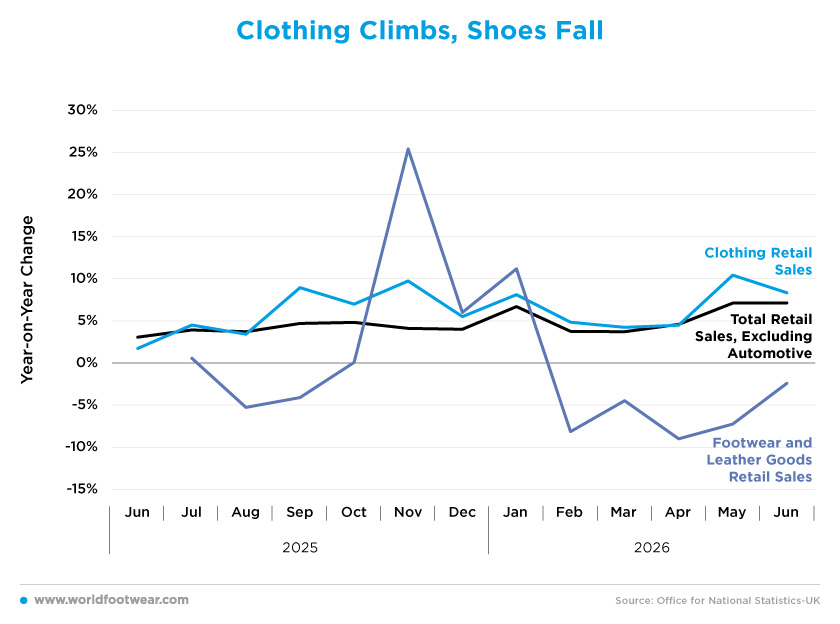
However, the key point is not simply that footwear is weaker than the total retail sector. It is weaker than clothing, despite belonging to the same broad fashion universe and operating in the same seasonal retail environment. While clothing appears to have benefited from favourable weather conditions, promotions and renewed summer demand, footwear did not. Combined with persistent footwear deflation, this suggests a category-specific demand problem rather than a general weakness in fashion retail.
Digital Fashion Climbs Faster
Online retail sales grew far faster than total retail sales throughout the analysed period. While total retail sales, excluding automotive fuel, grew by between 3.0% and 7.0% year-on-year (as presented in the previous section), total online retail sales increased by between 27% and 29%. This persistent gap shows that the digital channel was not merely supporting the market but expanding at a much faster pace than retail as a whole, with online growth being almost ten times higher than total retail growth in several months.This online outperformance is consistent with the late-spring retail trends. In May, online non-food sales rose strongly while in-store non-food sales remained negative. Helen Dickinson, Chief Executive of the British Retail Consortium, attributed this shift to the heatwave, stating that many consumers chose to shop online to avoid the heat, while seasonal demand lifted items such as sandals, sunglasses and lighter clothing (brc.org.uk).
The same pattern emerges in textile, clothing and footwear retailing. Online sales in the category grew by 28% year-on-year between June and September 2025, rising to 29% over the winter and reaching 30% to 31% in spring 2026. This was well above the growth recorded by clothing retail sales in the previous section – which was already relatively strong – and far above footwear and leather goods retail sales, which contracted from February onwards.
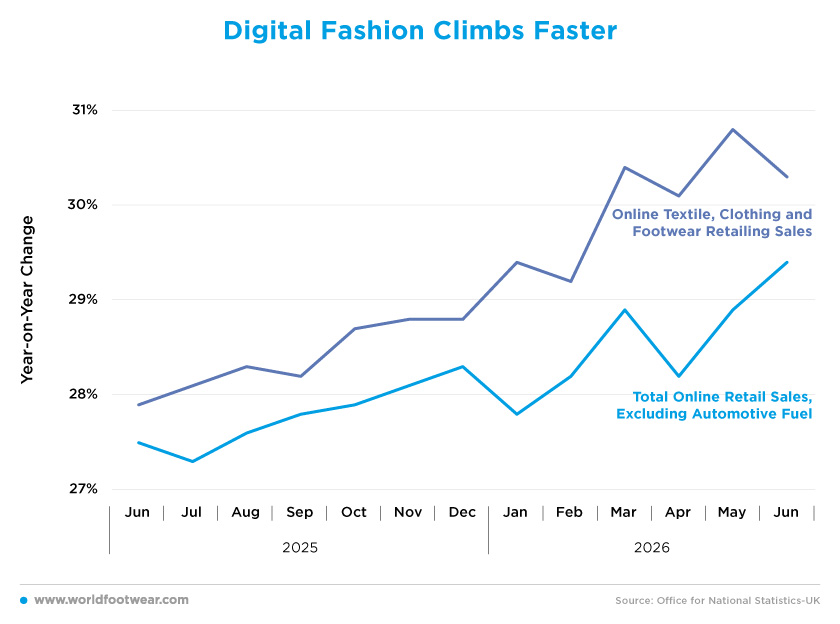
It is important to make a comparison with the previous section. While clothing sales were rising strongly, online textile, clothing and footwear sales were growing much faster. Footwear and leather goods, however, remained weak in the store-based retail data despite being part of a broader online category that was expanding rapidly. This suggests that the strength of online fashion retail did not translate evenly across all fashion segments.
The Fragile Footwear Chain
The footwear market is sending mixed signals, but the overall trend is cautious. Household consumption of footwear remained positive in the first quarter of 2025, growing by 5.1% year-on-year. However, growth slowed to 0.9% in the second quarter and turned negative in the third quarter, at -1.8%. It recovered only modestly in the final quarter to reach 1.4%. In the first quarter of 2026, household footwear consumption remained positive, but was only slightly so, at 0.6%.The decline in household spending on footwear fits a broader pattern of limited discretionary spending. Non-essential spending recovered only modestly, with 65% of households reporting financial adjustments and 45% saying they are cutting non-essential purchases. Julien Lafargue, Chief Market Strategist at Barclays Private Bank and Wealth Management, said that household demand was showing early signs of stabilisation, but warned that the macroeconomic backdrop remains “finely balanced” (home.barclays).
Footwear and leather goods retail sales were far more volatile. The category began 2025 weakly, with a 9.2% fall in January, before recovering in February and March. It then lost momentum again from May onwards, with contractions of 7.3% in June, 5.3% in August, and 4.2% in September. The surge in November of 25.2% stands out as an exceptional spike rather than the start of a stable recovery: sales grew again in December and January but then returned to contraction from February 2026 onwards.
Imports add another layer to the picture. The value of footwear imports rose sharply in some months of 2025, particularly in May and July, when they increased by 17.3% and 18.2%, respectively. However, this import strength did not coincide with a sustained improvement in retail sales. By contrast, imports fell sharply later in the year, with declines of 8.8% in October and 14.3% in November, despite a temporary improvement in retail sales. This suggests that retailers may have been selling through existing stock rather than replenishing supplies at the same rate.
The contraction in imports should also be considered in the context of the challenging operating environment faced by retailers. According to the British Retail Consortium, retailers were facing higher employment costs, packaging taxes and supply-chain disruption linked to the Iran conflict. While this does not directly explain the import figures, it does help to explain why retailers may have become more cautious about stock levels amid uncertain demand (brc.org.uk).
By 2026, the signals became more aligned. From January to May, footwear imports were negative, with the contraction deepening from -1.0% in January to -15.0% in April and -22.8% in May. Retail sales were also negative from February onwards. This simultaneous weakness in imports and retail sales suggests a more defensive market, where companies appear to have reduced their spending while consumer demand remained fragile.
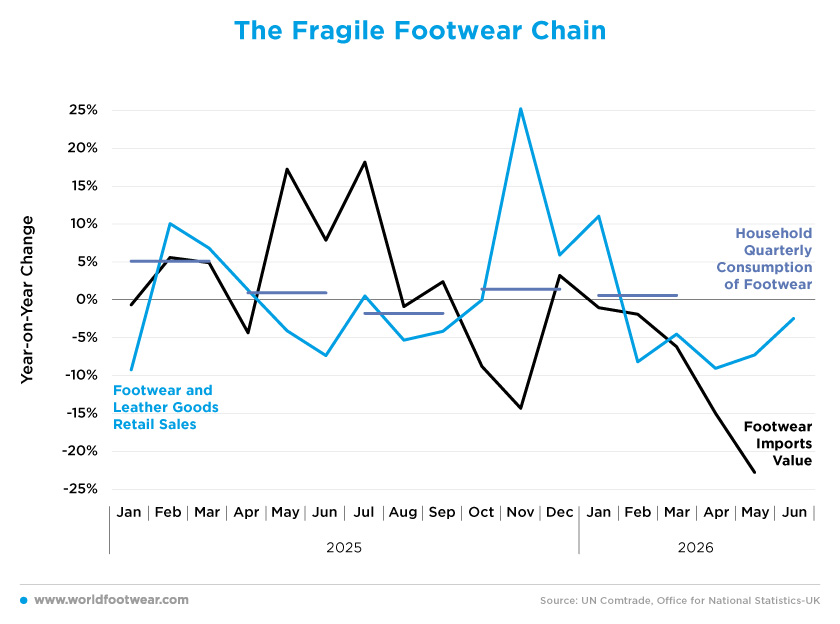
The clearest interpretation is that the weakness in the footwear sector was not confined to one indicator. Retail sales were volatile and mostly negative after January 2026, while household consumption slowed sharply compared to early 2025 and imports were cut back.