
Register to continue reading for free
US Retail: Footwear remains under pressure as consumers turn to value

The US footwear market started 2026 under pressure. Footwear inflation accelerated beyond headline inflation, while sales lagged behind those in the wider retail and fashion sectors. Additionally, a rebound in imports in late spring contrasted with weakening consumer confidence. Together, these trends point to a market where rising prices, uneven demand and recovering supply are creating a more challenging environment, with consumers becoming increasingly selective and value-conscious
Shoes Outpace Headline Prices
US inflation moved in two distinct phases. Between July 2025 and February 2026, all-items inflation remained relatively contained, fluctuating between 2.4% and 3.0%. It then accelerated sharply in spring 2026, rising from 3.3% in March to 3.8% in April and 4.2% in May. Although it eased to 3.5% in June and 3.3% in July, inflation remained above the levels recorded at the start of the year.The Federal Reserve interest rate followed the opposite path at first. It declined gradually from 4.3% in July and August 2025 to 3.6% by January 2026. From that point onwards, however, it remained unchanged, even as inflation accelerated in the spring. June brought some relief as energy prices eased, but Fed Chairman Kevin Warsh rejected the idea that the inflation problem had been solved, saying: “That is not my view (cnbc.com).
Footwear inflation changed more dramatically. In the second half of 2025, footwear prices were still rising more slowly than the all-items inflation and even slipped slightly into negative territory in November. By early 2026, however, the category had begun to catch up. Footwear inflation rose from 1.5% in February to 2.4% in March, and then overtook headline inflation in April, reaching 4.2%. It peaked at 5.2% in May, before easing to 4.1% in June and 3.4% in July.
In May, footwear inflation reached its fastest pace in almost four years, with women’s and men’s footwear prices also recording particularly sharp increases. Gary Raines, Chief Economist at the Footwear Distributors and Retailers of America (FDRA), attributed this to tariffs moving through the supply chain. He warned that this price pressure would continue to reach “store shelves and into less confident footwear shoppers’ pockets in 2026” (wwd.com).
The moderation in June did not fully reverse the pressure. Although footwear inflation eased from May’s peak, it remained above headline inflation and well above the rates recorded in the second half of 2025. This means that footwear shifted from being a relatively low-inflation category to being one of the areas of consumer goods inflation that is more exposed.
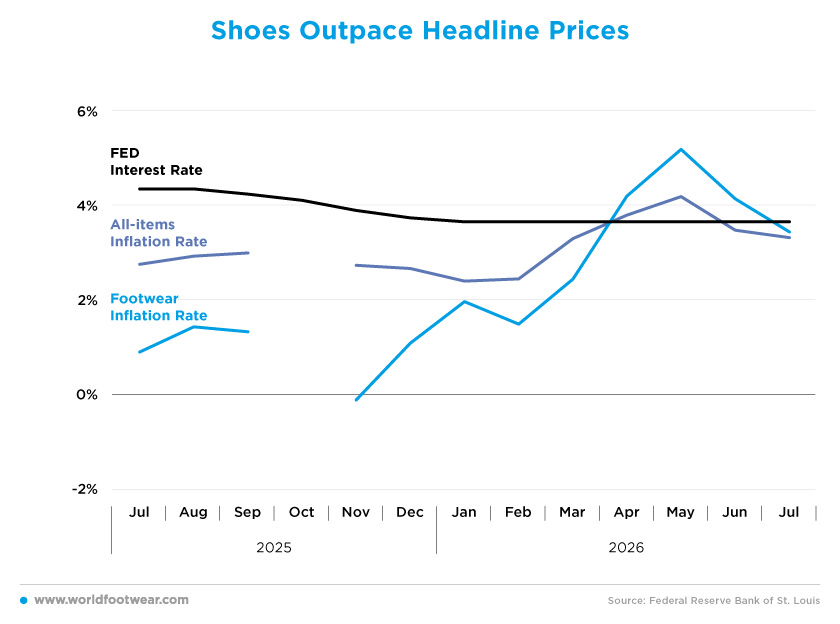
Note: The absence of figures in the graph for October 2025 reflects the fact that the Federal Reserve did not calculate or publish inflation data due to the government shutdown.
Shoes Miss the Retail Lift
US retail sales remained positive throughout the analysed period. Total retail sales grew by 3.5% year-on-year in June 2025, remaining in positive territory throughout the second half of the year, before strengthening in 2026. Growth rose to 7.5% in March, 6.9% in April, 7.0% in May, and 9.2% in June. This points to a resilient consumer market, despite elevated inflation and interest rates.Matthew Shay, President and CEO of the National Retail Federation (NRF), said in June that, while consumers were still willing to spend on retail goods, they were prioritising essentials and finding ways to make their household budgets go further.
Clothing and accessories retail sales were even stronger for most of the period. After rising by 2.8% in June 2025, sales in this category accelerated to 8.5% in July, remaining above 7% between August and November. Growth slowed in early 2026, falling from 8.5% in February to 4.6% in April, though it remained positive, reaching 5.3% in June. Clothing and accessories therefore continued to outperform total retail in much of 2025, although the gap narrowed as broader retail sales strengthened in 2026.
Footwear retail sales were more uneven. The category was almost flat in June 2025, at -0.1%, before improving in July and August. It then contracted again in September, recovered in October and November, before slowing sharply in December. At the start of 2026, the category appeared to regain strength, with sales rising by 5.5% in January and 10.7% in February. However, that momentum faded quickly: growth slowed to 3.1% in March and 1.0% in April, turned slightly negative in May, and recovered only modestly to 2.2% in June.
It is important to note the contrast between the two fashion-oriented categories: although both belong to discretionary consumer spending, their paths diverged. Clothing and accessories experienced steady positive growth, while footwear depended on short bursts of strength and lost momentum after February. This suggests that demand for footwear was not absent, but it was less stable and less broadly supported than in the wider fashion category.
Evidence from the athletic footwear market at company level helps to explain this weaker tone. In the second quarter, Dick's Sporting Goods reported that certain segments of the athletic footwear and apparel market had become more promotional. Its Foot Locker business was hit harder due to its greater exposure to legacy footwear silhouettes and its dependence on launch and retro products. There were fewer launches than expected, and performance was weaker than anticipated (investors.dicks.com).
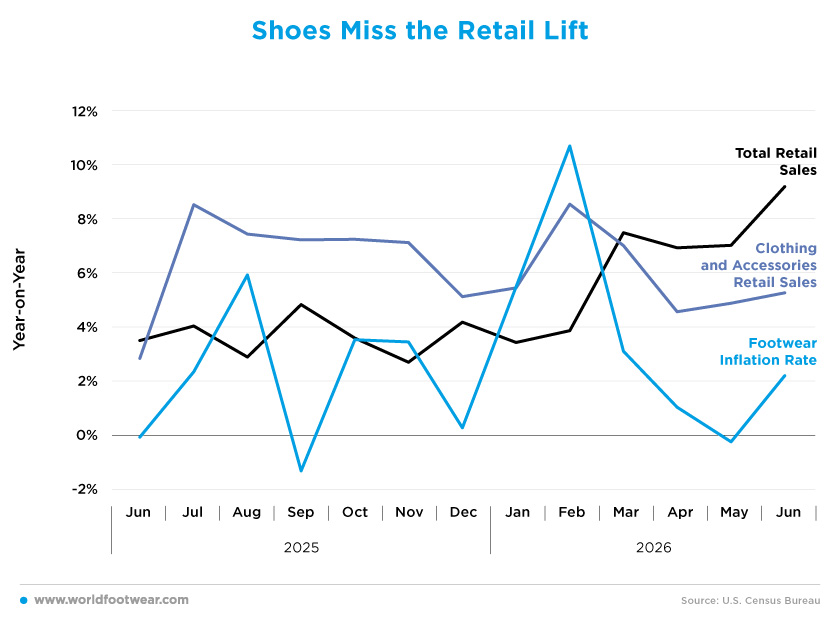
The result is a more nuanced picture than that shown in the inflation graph. Footwear prices were rising faster than headline inflation, but footwear retail sales were not accelerating in the same way. So, while broader retail demand remained resilient, and clothing and accessories continued to grow, footwear appeared more vulnerable to price pressure, promotions and weaknesses in the product cycle.
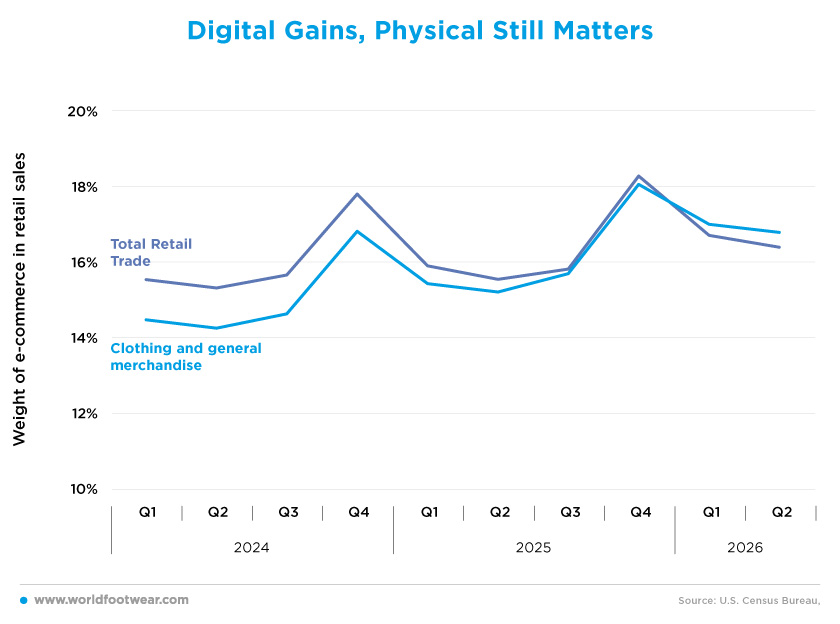
Digital Gains, Physical Still Matters
E-commerce remained an important, albeit relatively stable part of US retail sales. For total retail trade, the online share fluctuated within a narrow range for most of the period, moving between 15.3% and 15.9% from the first quarter of 2024 to the third quarter of 2025. The main exceptions were the final quarters, when the e-commerce share rose significantly, reaching 17.8% in 2024 and 18.3% in 2025. This suggests a clear seasonal effect, with online channels becoming more prominent during the holiday shopping period.Similar patterns were observed in clothing and general merchandise, but with a stronger upward trend. The online share rose from 14.5% in the first quarter of 2024 to 15.4% in the first quarter of 2025, and then to 17.0% in the first quarter of 2026. By the second quarter of 2026, e-commerce accounted for 16.8% of sales in clothing and general merchandise sales, compared to 16.4% for total retail trade. This represents a shift from 2024, when the category was slightly less reliant on online sales than retail as a whole.
The channel story is therefore not that e-commerce is replacing physical retail. Although online sales have increased, particularly in clothing and general merchandise, stores remain highly relevant. For the footwear category, the more significant implication is competitive pressure.
Imports Rebound, Confidence Does Not
Footwear import volumes remained low throughout the analysed period. Following a year-on-year decline of 2.6% in June 2025, imports declined more sharply in July, September, October, November and December, with contractions ranging from -15.1% to -19.7%. This trend continued into early 2026: imports were down by 13.0% in January, 10.1% in February, 1.5% in March and 12.1% in April.Consumer confidence also followed negative path, though there was some improvement at the start of 2026. The year-on-year change in confidence deteriorated in the second half of 2025, falling from -7.1% in July to -29.0% in November. It then became less negative in early 2026, reaching -4.6% in April. However, this improvement was short-lived: confidence weakened again, reaching -14.2% in May and -18.5% in June.
Footwear import prices moved differently. The average import price remained at around 13 to 14 dollars per pair for most of 2025, peaking at 14.28 dollars in November. It then fell sharply to 11.80 dollars in January 2026 and 11.84 dollars in February, before stabilising at around 13.30 dollars between March and June. This suggests that the adjustment in imports was not solely due to changes in volume; changes in the mix of products sourced or the timing of imports may also have affected the average price of imported footwear.
According to the National Retail Federation (NRF), retailers and importers brought forward the arrival of in response to tariff risk and supply-chain uncertainty. Import volumes at major US container ports were expected to remain high over the summer before declining later in the year, after an early peak season linked to tariff changes and the disruption caused by the conflict in Iran. This context also helps to explain why the rebound in footwear import volumes in May and June should be viewed with caution, as it may reflect stockpiling rather than a genuine improvement in underlying demand (nrf.com).
That distinction is important. In May 2026, footwear import volumes jumped by 20.7%, remaining positive in June at 3.4%. However, this rebound came amid weakening consumer confidence and following several months of negative import growth. Therefore, the data points less to a broad recovery than to a temporary restocking or timing effect.
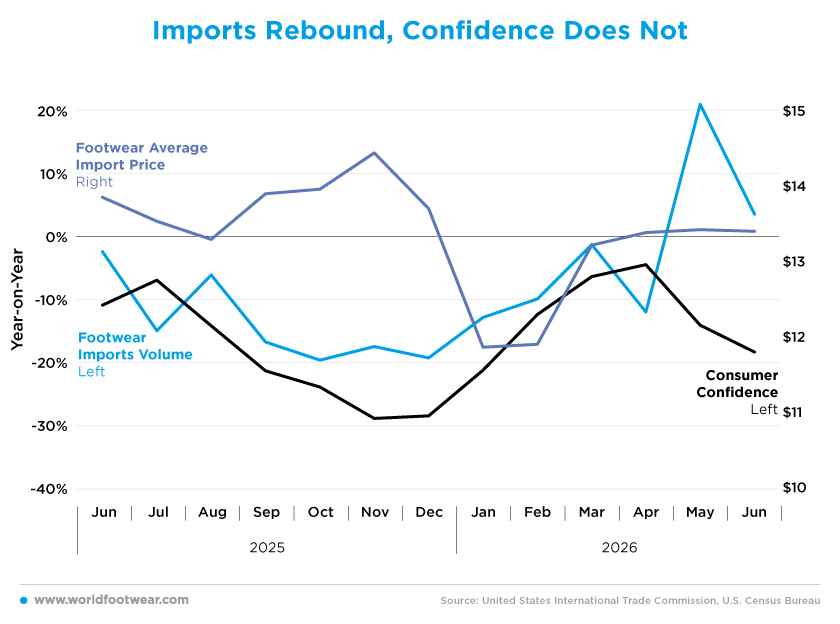
The overall picture is thus one of supply outpacing demand. Although imports recovered sharply in late spring, confidence did not. Average import prices also rebounded after dipping in early 2026, at a time when consumers were becoming more cautious and footwear prices at retail were rising. The risk for the footwear market is that frontloaded supply will meet consumers who are still looking for value and buying more selectively.