
Register to continue reading for free
Germany Retail: Footwear remains under pressure

The German footwear market is under increasing pressure due to declining sales, rising prices and weakening consumer confidence. While total retail and online sales have remained relatively resilient, footwear and leather goods have consistently underperformed. Meanwhile, retailers have become more cautious, as reflected in declining imports and weak retail confidence, which points to a challenging environment for the sector
Retail Weakens, Footwear Falls Further
German retail sales showed signs of weakening over the period analysed. Total retail sales grew strongly in May and June 2025, by 5.4% and 3.1% respectively, and remained mostly positive through the end of the year. However, the picture deteriorated in 2026. Following a modest growth in January and February, and a stronger reading in March, total retail sales fell by 2.2% in April and 2.9% in May.Although online sales remained more resilient, they also lost momentum. Growth was very strong in the first half of the period, with increases of 16.3% in May 2025, 17.6% in June, and 16.7% in July. From August onwards, however, online growth became more moderate, falling to 4.8% in August and remaining mostly in single digits. In March 2026, online sales rose by 7.8% but slowed to 0.8% in April and 2.0% in May.
Recent e-commerce indicators confirm that online retail continues to be a key driver of the German retail sector, even in a weak consumer environment. However, growth is uneven across channels and categories. On top of this, although fashion online sales have continued to grow, but Asian platforms are gaining market share rapidly, particularly in online fashion, where they now account for a significant proportion of orders (bevh.org).
Footwear and leather goods are clearly the weakest part of the graph. Retail sales in this category fell every month during the period analysed. While the decline was moderate in some months, such as January 2026 when sales fell by 0.9%, it deepened sharply in others, reaching -7.2% in July 2025, -6.0% in November, and -11.6% in April 2026. Even in months when total retail sales expanded, footwear and leather goods remained in decline.
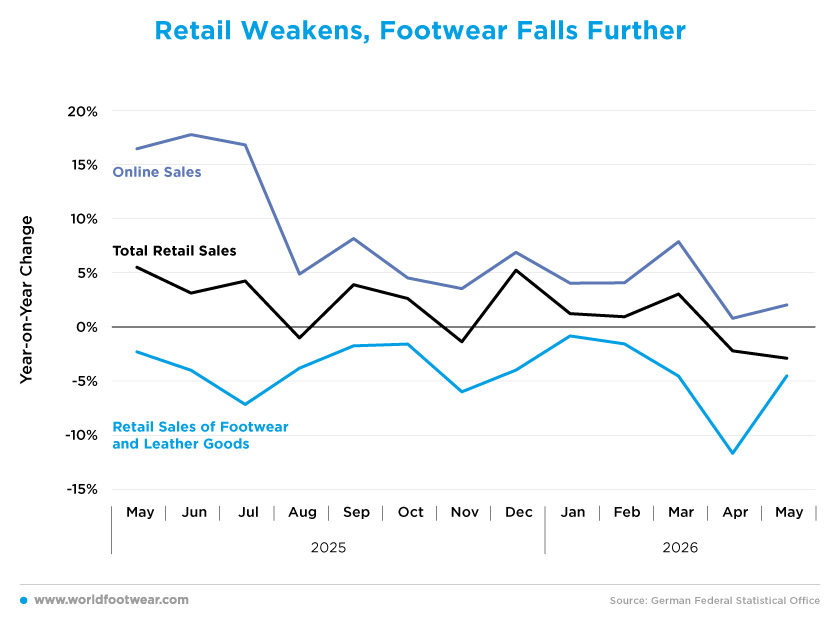
The German retail market is becoming increasingly fragmented. Although growth has slowed from the double-digit rates recorded in mid-2025, online sales continue to provide support. Total retail has also weakened in recent months, while demand for footwear and leather goods remains persistently low. The category is therefore not simply moving with the retail cycle; it appears to be facing a more specific and long-term demand weakness.
Shoes Edge Into Inflation
German inflation remained positive but relatively contained over the analysed period. All-items inflation stood at 2.0% in June and July 2025, rising to 2.4% in September before remaining above 2% for most of the subsequent months. After easing to 1.8% in December, inflation accelerated again in early 2026, reaching 2.7% in March and 2.9% in April, before slowing to 2.6% in May.Inflation in the fashion (clothing and footwear) sector remained more subdued than headline inflation. Prices fluctuated between slight deflation and moderate growth for most of the period, falling by 0.3% in June 2025 and 0.6% in December, before rising by 1.2% in February and 1.3% in March 2026. However, this increase did not persist at the same pace, with fashion inflation slowing to 0.4% in April and May before standing at 0.8% in June.
Footwear prices followed a more pronounced upward trend. Inflation was negative for several months in 2025, including in August and December, when footwear prices fell by 0.5% and 2.1%, respectively. However, from January 2026 onwards, footwear inflation remained positive and gradually strengthened, rising from 0.4% in January to 1.4% in April and 2.2% in June. By the end of the period, footwear inflation had almost caught up with headline inflation.
Earlier inflation data had already indicated some underlying pressure. Although the decline in headline inflation in May was driven by lower energy prices, core inflation and services inflation increased. Furthermore, selling-price expectations had strengthened. This suggested that cost pressures remained relevant, even if they had not yet spread evenly across the economy (reuters.com).
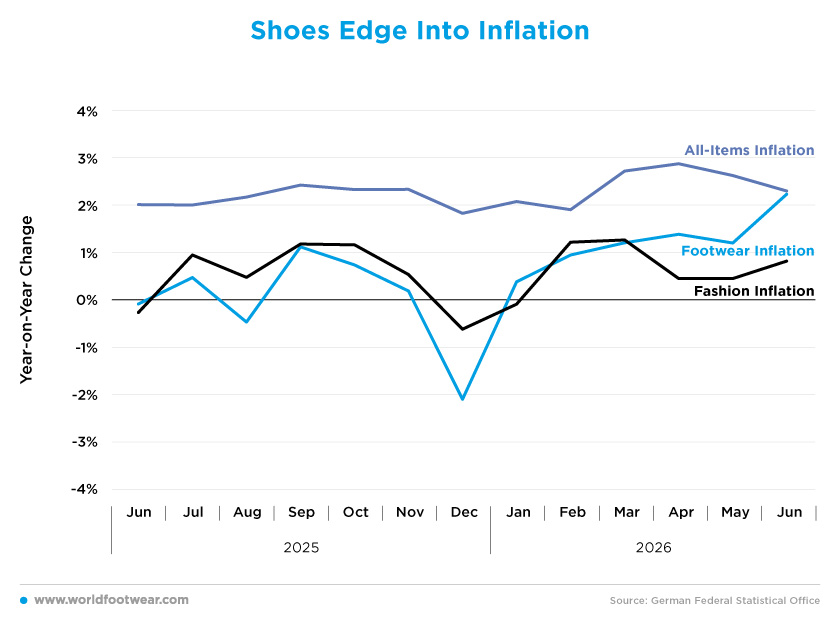
The result is an uneven price picture within the sector. While fashion prices remained relatively muted, footwear moved from deflation in late 2025 to inflation close to the all-items rate by June 2026. This does not make footwear a major inflation driver, but it does show that the category was subject to greater price pressure in the first half of 2026.
The Footwear Confidence Problem
The previous sections revealed two significant developments in the German footwear market: retail sales of footwear contracted compared to the previous year, while footwear inflation gradually increased in 2026. This graph brings these trends together alongside the marked weakening of consumer confidence in the spring.Footwear sales were already under pressure in 2025, but this intensified early 2026. Following relatively moderate declines in January and February, sales fell by 4.5% in March and then by 11.6% in April, marking the weakest reading in the series. At the same time, footwear inflation remained positive, rising from 0.9% in February to 1.2% in March and 1.4% in April, before reaching 2.2% in June.
Rather than providing support, consumer confidence moved in the same negative direction as sales. After fluctuating between -8.9 and -12.0 in the second half of 2025, the indicator deteriorated sharply in 2026, falling to -13.5 in March and -17.6 in April. Although it improved slightly in May and June, it remained much weaker than in most of the previous year.
The Nuremberg Institute for Market Decisions’ consumer climate indicator confirms this fragile backdrop, with the willingness to buy still in pessimistic territory and the willingness to save staying high. Although income expectations and economic expectations improved slightly, there were still no clear signs of a return to pre-war levels of confidence (nim.org).
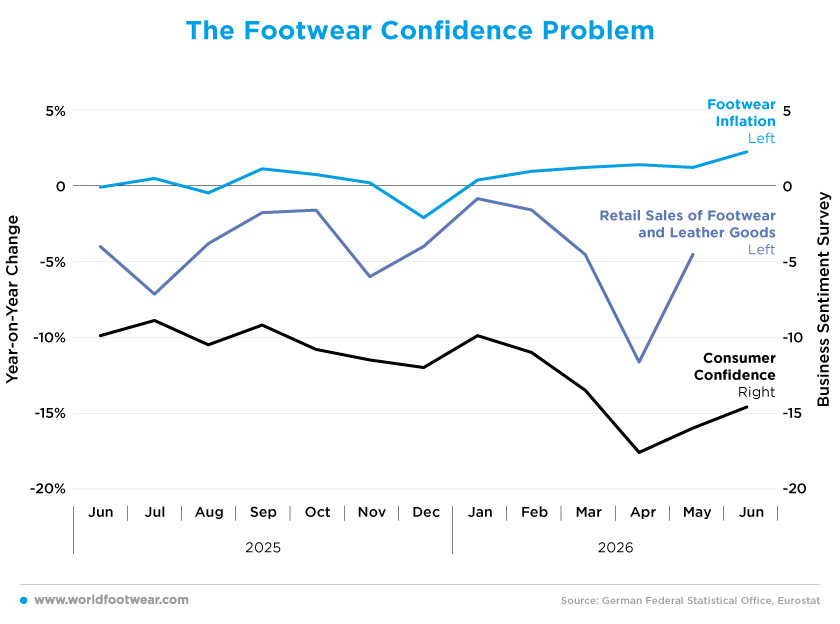
The sharp fall in footwear sales in April therefore appears less like an isolated category movement and more like the point at which weak sentiment, cautious spending and rising footwear prices overlapped. The subsequent improvement in May reduced the severity of the decline but did not reverse the broader weakness in the category.
The same tension is visible in the retail sector’s own assessment. Prior to the boost from the World Cup, demand in the retail of textiles, footwear and leather goods remained subdued, with consumers still price-sensitive and careful in their spending. Even during a major emotional event such as the tournament, broader economic and political uncertainty continues to influence consumer spending habits (bte.de).
Retailers Pull Back On Imports
Over the analysed period, footwear imports into Germany changed direction sharply. In 2025, import values were still mostly positive, with significant growth in May, June and July, at 26.3%, 18.0% and 22.6%, respectively. Growth then weakened during the second half of the year and turned clearly negative in 2026: imports fell by 10.8% in January, 11.0% in February, 5.9% in March and 18.3% in April.Retail confidence remained negative throughout this period. After improving from -25.7 in April 2025 to -20.0 in May, the indicator weakened again for the remainder of the year. The deterioration became more pronounced in 2026, with retail confidence falling from around -25 in the first quarter to -31.2 in April and -31.3 in May. Although it recovered slightly to -25.8 by July, it remained firmly below zero.
This is consistent with the concerns expressed by German textile, footwear and leather goods retailers. The sector has called for measures to strengthen consumers’ spending power, reduce bureaucracy, keep labour costs affordable and improve competitive conditions. Retailers have also warned that delayed support does little to solve immediate problems relating to liquidity, inventory and margin problems (bte.de).
Competitive pressure is also coming from digital channels and international platforms. Asian online platforms are increasing their share of the German e-commerce market, especially in fashion. Meanwhile, expected customs changes are not expected to have a significant impact on low-cost imports from Asia, as suppliers are already establishing logistics structures within Europe (bevh.org).
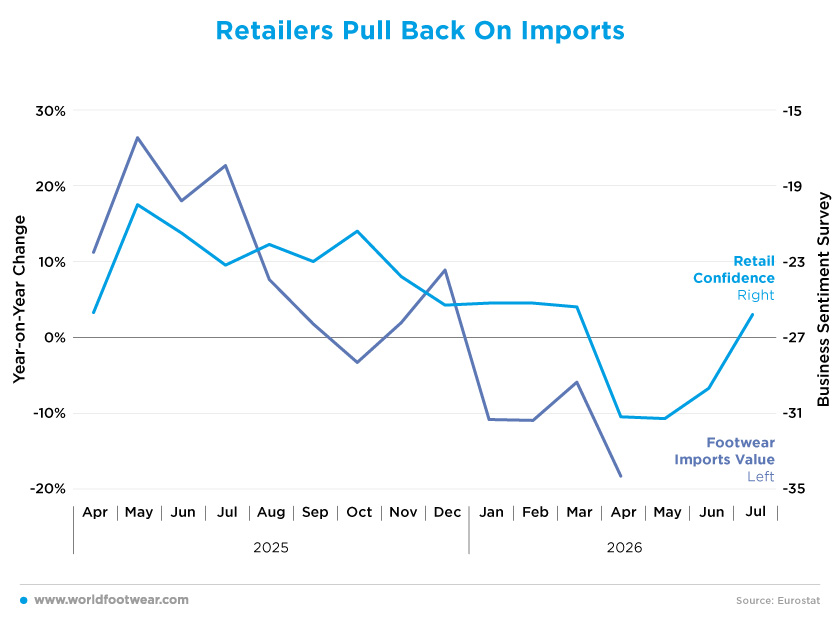
The contraction in footwear imports at the start of 2026 may therefore indicate a more cautious approach to stock and purchasing decisions. Following a period of strong import growth in 2025, weaker retail confidence, ongoing sales declines in footwear and leather goods, and pressure on margins may have prompted companies to minimise their exposure to unsold inventory.