
Register to continue reading for free
Japan Retail: Higher rates meet an uneven fashion recovery

Against a backdrop of renewed price pressures and a weaker yen, the Japanese fashion market has experienced an uneven recovery. Interest rates have continued to rise, and consumer confidence remains subdued. Within the fashion sector, clothing inflation has outpaced that of footwear. Commercial sales also diverged, with textile sales enjoying a strong rebound, whereas apparel and accessories only returned to marginal growth. Meanwhile, despite falling volumes, footwear import value held up, supported by higher average prices
Rates Rise, Confidence Lags
Japan’s inflationary environment changed markedly over the analysed period. All-items inflation remained close to 3% throughout most of the second half of 2025, before slowing sharply to 2.1% in December and falling to 1.5% in January 2026. It remained subdued through April, fluctuating between 1.3% and 1.4%, before accelerating again to reach 1.7% in June and 2.1% in July.Meanwhile, the Bank of Japan continued to normalise its monetary policy. The interest rate remained at 0.48% between July and November 2025, before rising to 0.56% in December 2025 and 0.73% in January 2026. After remaining unchanged until May, the rate increased again, reaching 0.84% in June and 0.98% in July. This resulted in an unusual combination that showcases the specificity of Japan: monetary policy was becoming progressively tighter even though headline inflation had been below 2% for several months.
The Bank of Japan is paying increasing attention to the risk of renewed price pressures. Governor Kazuo Ueda said that, as underlying inflation approached the central bank’s 2% objective, policymakers needed to pay “greater attention than before to upside risks”. Recent service-sector data also showed persistent cost pressures, strengthening expectations of further monetary tightening (japantimes.co.jp).
Consumer confidence initially moved in a more favourable direction. The index increased from 33.7 in July 2025 to 38.5 in October, reaching its highest level of 39.7 in February 2026. This improvement then reversed abruptly, with confidence falling to 33.3 in March and 32.2 in April. Sentiment subsequently recovered, albeit gradually, reaching 35.5 by August, but remaining well below the February peak.
The deterioration in household sentiment coincided with the economic effects of the Iran conflict, as higher energy costs and renewed inflationary pressure took their toll on consumers. Masato Koike, senior economist at Sompo Institute Plus, warned that “downward pressure on consumption is expected to intensify as higher prices become more pronounced going forward” (reuters.com).
The moderate recovery in confidence from April onwards therefore did not amount to a return to the stronger sentiment observed at the beginning of the year. By August, the index had improved to 35.5, but remained 4.2 points below the February peak. At the same time, inflation had started to rise again and interest rates had continued to increase.
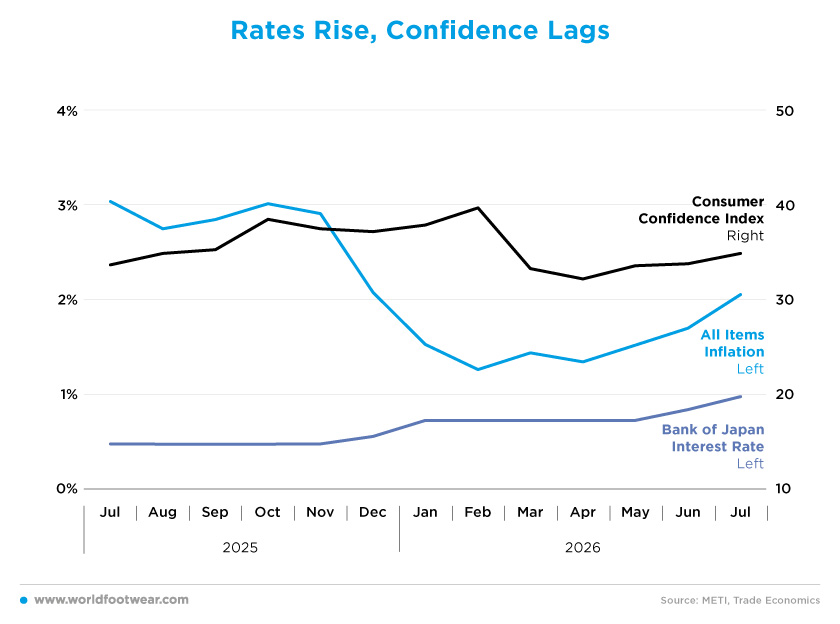
This leaves Japanese households facing an increasingly delicate situation, with inflation no longer falling while borrowing conditions are becoming tighter. Against this backdrop, consumer confidence recovered only partially from its spring decline. Thus, while the macroeconomic backdrop has improved in some respects, household sentiment continues to lag behind the Bank of Japan’s monetary normalisation efforts.
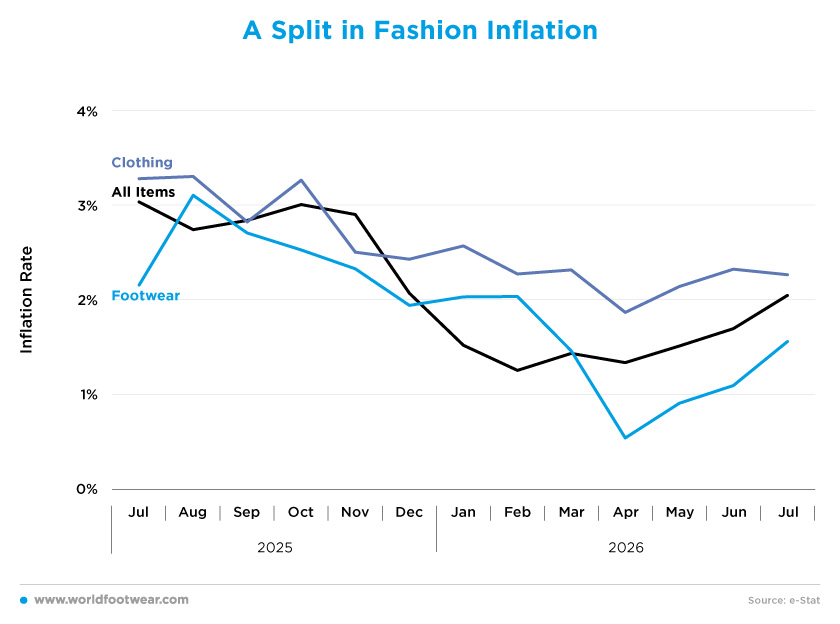
A Split in Fashion Inflation
From the second half of 2025 into early 2026, inflation eased across all three series, but the adjustment was uneven. All-items inflation declined from 3.0% in July 2025 to 1.5% in January 2026, reaching a low of 1.3% in February and April. It then strengthened again, rising to 1.7% in June and 2.1% in July.Clothing prices proved more persistent. Clothing inflation remained close to or above 3% throughout much of the second half of 2025 and, although it moderated in 2026, it remained above all-items inflation in every month from January to July. Even at its lowest point, in April, clothing inflation remained at 1.9%, before returning to 2.3% in June and July.
The path of footwear was different. Inflation stood at 2.2% in July 2025 and peaked at 3.1% in August, before gradually easing. Footwear prices were still rising faster than headline inflation between January and March 2026, but then inflation dropped sharply to 0.5% in April. It recovered gradually, reaching 0.9% in May, 1.1% in June, and 1.6% in July, remaining below clothing and all-items inflation.
The divergence within fashion is therefore notable. While clothing inflation remained comparatively high even as headline inflation fell, footwear experienced much weaker price growth from the spring onwards. This may indicate greater competitive pressure on prices or a weaker ability to pass on costs through in the footwear sector than in clothing.
Nevertheless, broader price pressures began to re-emerge by the summer. A weaker yen continued to raise the cost of imported food and energy, while higher crude oil prices, linked to the conflict in the Middle East, were increasingly feeding on the cost of household goods. Takeshi Minami, chief economist at the Norinchukin Research Institute, expects inflation to remain above 2% from autumn onwards (japantimes.co.jp).
Textiles Lead the Turnaround
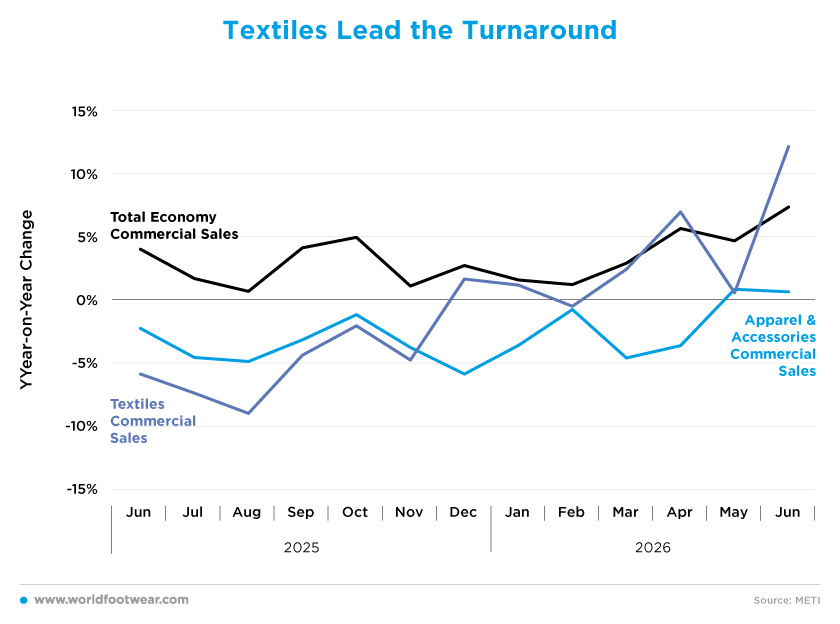
Commercial sales in Japan remained positive at the aggregate level throughout the period analysed. Total economy sales grew by 4.0% year-on-year in June 2025 and, despite slowing to 0.6% in August and 1.0% in November, growth strengthened again in 2026. They accelerated from 1.2% in February to 5.6% in April, 4.6% in May and 7.3% in June.The trajectory of apparel and accessories was considerably weaker. Sales contracted throughout 2025, ranging from -1.2% in October to -5.9% in December. This weakness persisted into early 2026, with further falls of 3.6% in January and 4.6% in March. The category finally returned to growth in May, with an increase of 0.8%, and remained marginally positive in June, at 0.6%. The improvement therefore represents a stabilisation rather than a recovery comparable with that of total commercial sales.
Textiles showed a much sharper turnaround. Following substantial contractions in mid-2025, including -7.4% in July and -9.0% in August, sales returned to positive territory in December. Performance was uneven at the start of 2026, but strengthened clearly thereafter, with sales rising by 2.4% in March, 6.9% in April, and 12.1% in June. By the end of the period, textiles had transformed from the weakest to the fastest-growing of the three sectors.
Performance among individual fashion retailers was nevertheless stronger in some parts of the market. UNIQLO Japan reported a 10.0% increase in revenue and a 9.9% rise in same-store sales in the three months to May 2026, supported by strong demand for trend-led bottoms and functional products designed for changing temperatures. The company also ran more strategic promotions during key sales periods (fastretailing.com).
Value Holds as Volumes Retreat
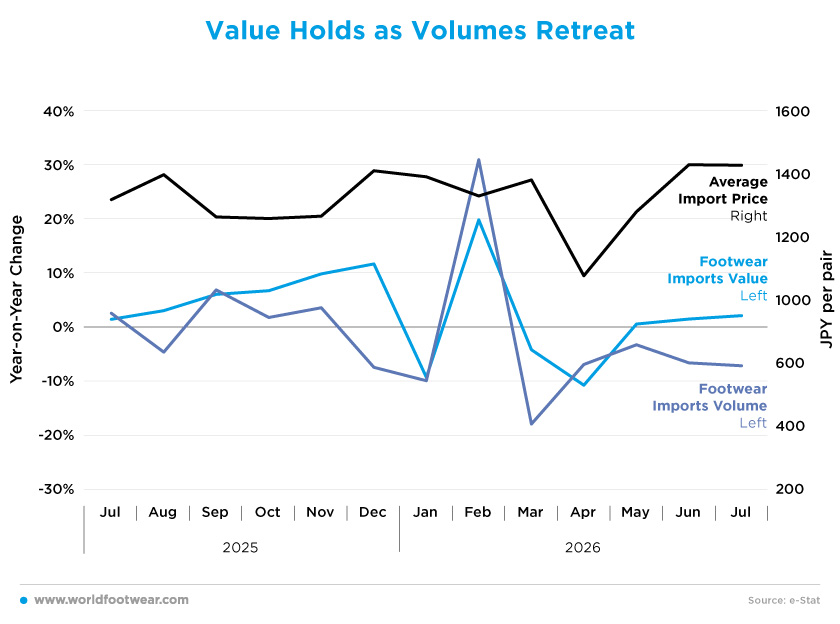
Japan’s footwear imports were highly volatile during the analysed period, but value generally performed better than volume. In the second half of 2025, import value remained positive every month, accelerating from 1.5% year-on-year in July to 11.7% in December. In contrast, import volumes were considerably weaker, fluctuating between growth and contraction, and falling by 7.4% in December. This divergence was accompanied by a rise in the average import price, which reached 1,378.6 yen per pair at the end of the year.Volatility increased in early 2026. Both import value and volume contracted in January, before rebounding sharply in the following month of February, with value rising by 19.8% and volume by 31.0%. This surge was immediately reversed in March, with volume falling by 17.9% and value declining by a much smaller 4.2%. April brought another contraction in both measures, as well as unusually sharp fall in the average import price to 990.6 yen per pair, the lowest point of the period.
From May onwards, however, a clearer pattern emerged. Import volumes remained negative, falling by 3.2% in May, 6.5% in June, and 7.1% in July. Meanwhile, import value returned to modest growth, rising by 0.6%, 1.5%, and 2.2%, respectively. At the same time, the average import price climbed sharply, reaching 1,400.9 yen per pair in June and remaining close to this figure in July.
The widening gap between value and volume suggests that the value of footwear entering Japan was increasingly driven by higher average prices rather than by a larger number of pairs. This may be due to changes in the product or sourcing mix, exchange-rate effects or higher underlying import costs. However, the data alone do not allow these influences to be fully identified.
The currency environment provides important context. During 2026, the yen weakened to levels not seen in four decades, putting pressure on Japanese importers, while authorities repeatedly intervened to support the currency. By late July, the yen had fallen to as far as 163.99 yen per US dollars, before coordinated intervention by Japan and the United States. This was followed by a period of improvement in sentiment towards the currency (japantimes.co.jp).
For footwear, the mid-2026 picture is therefore not one of expanding import demand. Even though their aggregate value edged higher, fewer pairs entered the Japanese market than a year earlier. Alongside the weak apparel sales seen in the previous graph, the increase in average import prices suggests that the market is shifting towards generating value through unit price rather than volume.