
Register to continue reading for free
Netherlands Retail: footwear sales pick up amid market pressures

The Dutch footwear market showed mixed developments during the summer months. The footwear and leather goods sector recorded three consecutive months of year-on-year turnover growth, which coincided with increased household spending despite negative consumer confidence. At the same time, footwear prices continued to fall compared with a year earlier, while retailers faced rising costs in sourcing, logistics and labour. Online sales continued to outperform the total retail sector, although growth in sales volumes moderated in September
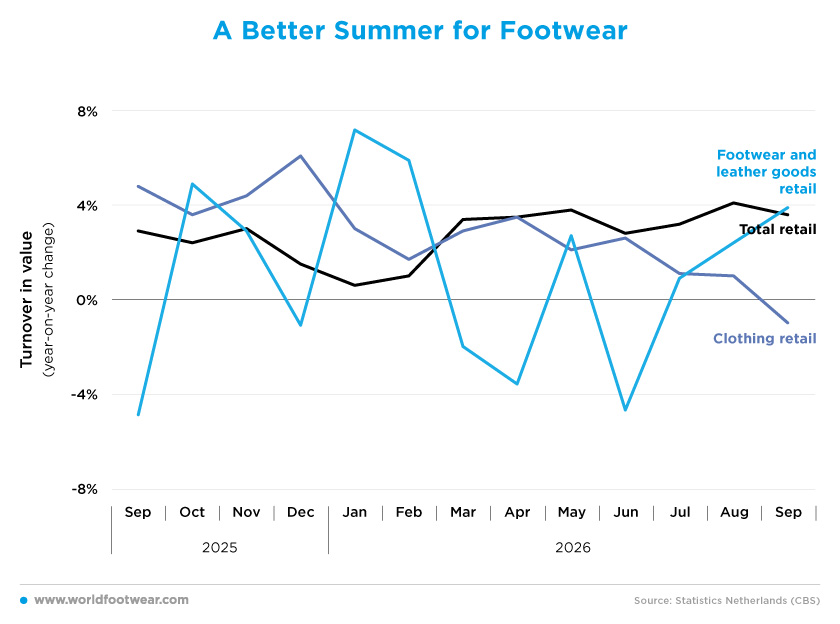
A Better Summer for Footwear
Dutch footwear retailers reached autumn with a more encouraging run of sales, with turnover in stores selling footwear and leather goods increasing for three consecutive months after repeatedly losing momentum earlier in 2026.Growth strengthened from 0.9% year-on-year in July, to 2.4% in August and finally to 3.9% in September, when the category moved slightly ahead of total retail, which stood at 3.6%. Over the same period, clothing sales weakened, with turnover growth slowing from 1.1% in July to 1.0% in August, before turning negative in September, at −1.0%. This left footwear in a stronger position within the fashion sector than it had occupied for much of the spring.
Improvements were also visible in sales volumes, which rose by 2.7% in July, 2.6% in August, and 4.5% in September for footwear and leather goods. These increases came as households were spending more on goods in general. Statistics Netherlands (CBS) reported that household consumption grew by 2.1% in volume terms in August, with spending on durable goods up by 5.5%, particularly on cars, electrical appliances and home furnishings (cbs.nl).
Therefore, the recovery in footwear was therefore taking place alongside stronger spending in other discretionary categories, even though these purchases had not been accompanied by a comparable recovery in consumer confidence.
Given the reversals already seen this year, some caution is still warranted. Footwear turnover grew by 7.2% in January and by 5.9% in February but then fell again in March and April. A recovery in May was followed by a further decline of 4.7% in June. While three positive months provide a firmer basis than a single rebound, the earlier fluctuations show how easily an improvement in sales can give way to another weak month, particularly when the wider retail market continues to grow only moderately.
Household incomes offer one explanation for the gap between spending and sentiment. ING’s October assessment notes that wage growth remains above inflation, supporting real disposable income. Meanwhile, household consumption was the largest contributor to GDP growth in the second quarter, despite low confidence. However, the bank expects this support to weaken as wage growth slows, taxes increase, and the temporary boost to pension incomes fades, leaving purchasing-power gains close to zero for many households in 2027 (think.ing.com).
For footwear retailers, the summer improvement has consequently arrived while households are still benefiting from income gains that may become harder to sustain.
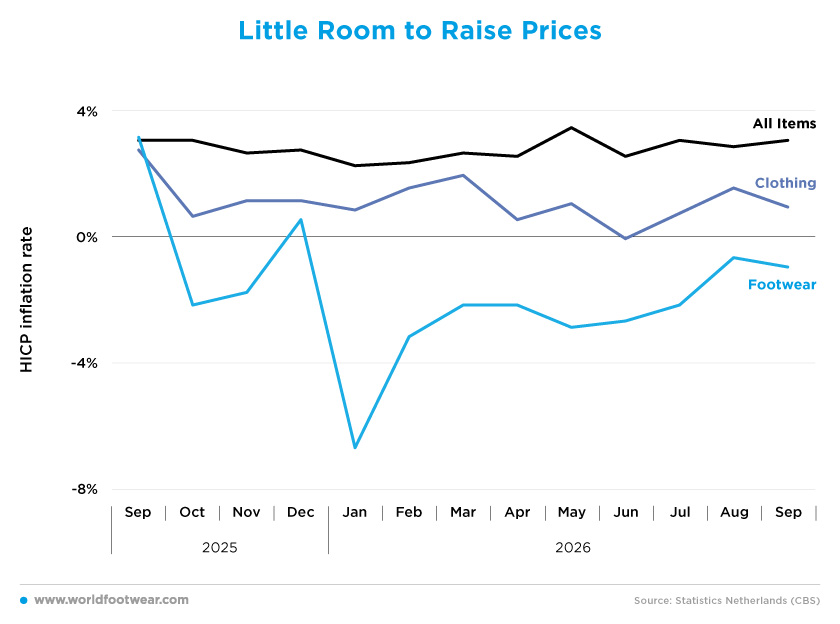
Little Room to Raise Prices
The recovery in footwear sales has brought provided only limited relief for retailers, who continue to operate in a market where shoes are cheaper than a year earlier, while many business costs are increasing.ING’s September retail assessment highlights rising sourcing, logistics and labour costs across the sector, as well as fierce competition and price-sensitive consumers. It also identifies shoes among the products whose prices have fallen, alongside furniture and consumer electronics (think.ing.com). Although the increase in sales volumes is welcome, higher activity alone gives little indication of how much of the additional turnover retailers can retain after meeting these costs.
Footwear inflation, as measured by the harmonised index of consumer prices (HICP), remained negative every month from January to September 2026.
The annual price decline narrowed from 6.7% in January to 2.7% in June, 2.2% in July, and 0.7% in August, before widening slightly to 1.0% in September. In contrast, clothing prices were comparatively more stable, ending September 0.9% above their year-earlier level, while headline HICP inflation stood at 3.0%, having fluctuated between 2.5% and 3.4% since May.
The recent recovery in footwear turnover has thus occurred alongside continued price declines, rather than following a return to the more favourable pricing environment seen elsewhere in the consumer economy.
This divergence also affects household budgets, since cheaper footwear does not offset the pressure created by rising costs in other spending categories. In its analysis of September’s harmonised inflation figures, The ING Bank identified services as the main source of Dutch inflation, with higher fuel prices being an important cause of the latest acceleration, particularly regarding transport and travel-related services. The bank expects some energy costs to reach consumers gradually, since many households have fixed-prices contracts lasting one or two years (think.ing.com).
Therefore, footwear retailers face customers who remain exposed to broader inflation even as shoe prices fall, which limits the potential for a sales recovery to result in stronger pricing power.
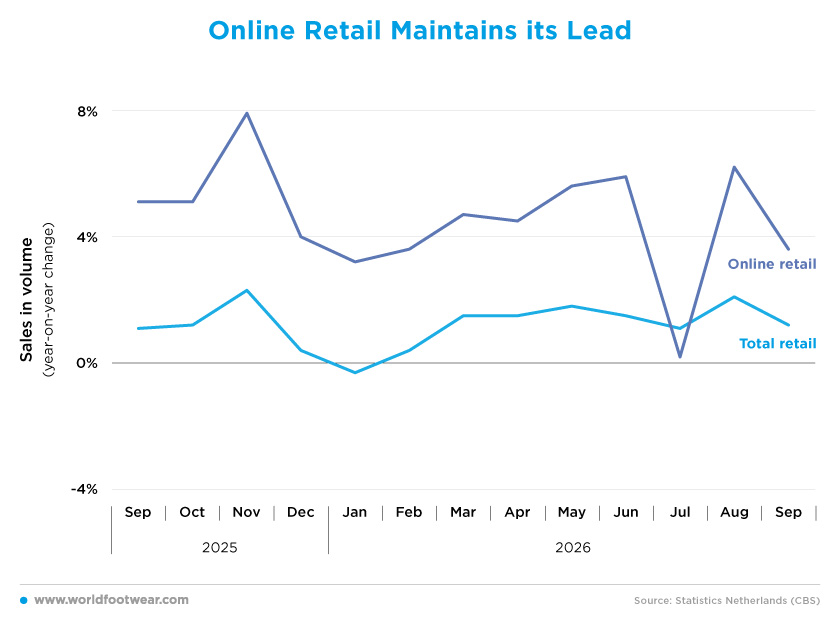
Online Retail Maintains Its Lead
Throughout the first half of 2026, online retail grew faster than the wider Dutch retail market, with sales volumes increasing by 3.2% year-on-year in January and 3.6% in February, before settling between 4.5% and 5.9% from March to June. In contrast, total retail volumes were much weaker, declining by 0.3% in January and growing by between 0.4% and 1.8% in the subsequent five months. By June, the gap had widened to 4.4 percentage points, with online volume growth reaching 5.9% against 1.5% for retail as a whole.Turnover in value terms also increased in every month from January to September. Annual growth ranged from 1.7% to 6.7% in the first half of the year, slowing to 2.5% in July before strengthening to 7.6% in August and 7.7% in September. This latest figure was more than twice the 3.6% recorded for total retail, confirming that internet retailers continued to outperform the wider market in terms of both sales value and volume. There is, however, a growing difference between the two measures: September’s 7.7% increase in online turnover was accompanied by a considerably smaller 3.6% rise in sales volumes.
The summer figures also show that the channel’s progress has been uneven. Online volume growth slowed to just 0.2% in July, falling below the 1.1% recorded in total retail for the first time in 2026 so far, before rebounding to 6.2% in August. September’s subsequent moderation to 3.6% left volume growth below the 5.1% recorded a year earlier, even though turnover growth strengthened. Consequently, online retail therefore entered the autumn with sales still expanding, albeit with less vigorous growth in volumes accompanying the latest increase in revenue.
The competitive landscape within the channel is also changing. ING’s September report describes how multichannel retailers are gaining ground online, partly due to growth in supermarkets and drugstores, where they already have a strong position. Traditional retailers have also invested in websites, apps, and logistics, enabling them to offer online shopping alongside services supported by their store networks, such as click-and-collect and local fulfilment (think.ing.com).
While these developments concern the wider retail market rather than footwear specifically, they suggest that physical stores can play a useful role in competing for online sales.
The August Import Drop
The footwear import figures in August interrupted the more stable performance seen in terms of volume in June and July, with the import value falling by 40.8% year-on-year and the number of pairs by 19.1%. As the fall in value was much larger than the reduction in volume, the average value per imported pair decreased. This means that the change cannot be solely attributed to fewer shoes entering the market. However, the figures do not identify the cause of the shift in average value, and one single month is insufficient to determine whether the contraction in August marks a lasting change.Considerable variation had already been evident in the preceding months. Import value fell throughout the first quarter, with a decline of 14.9% in value and 14.0% in pairs in March, before returning to modest growth in June and July. Volumes were more stable during this period, falling by 1.0% in June and increasing by 0.4% in July, making the subsequent decline in August particularly noticeable. Thus, the series contains both periods of contraction and temporary improvements, rather than a steady deterioration, which would make the latest fall easier to interpret.
Retailers’ own assessment has remained more favourable than the trade figures might suggest. In the European Commission survey, retail confidence was positive throughout the period, reaching 9.0 in July, before easing to 3.5 in September, and recovering to 4.2 in October. Although the latest reading was below the summer peak, it still indicated a positive outlook for retail as a whole. This provides a useful business context and is broader than the footwear sector covered by the import data.
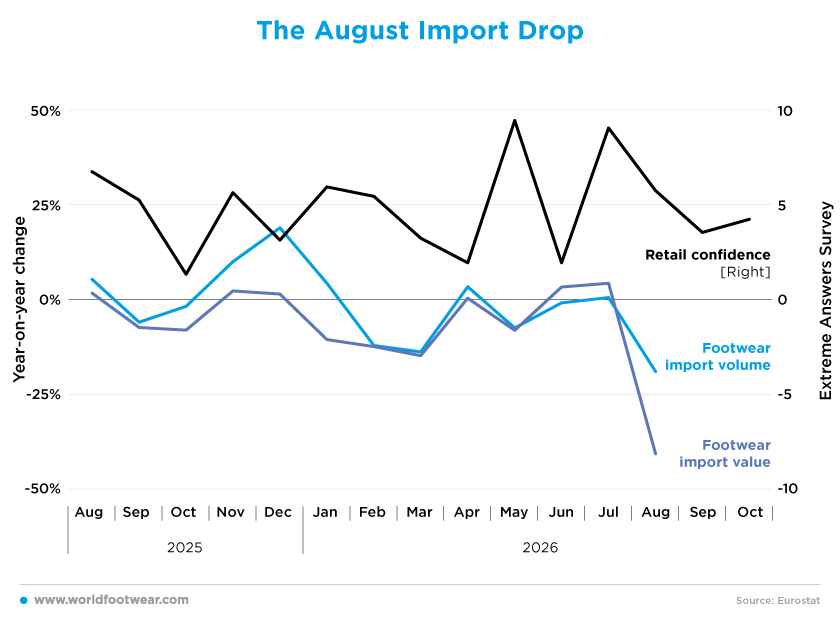
According to the same source, consumer confidence remained negative, falling from −16.0 in September to −19.0 in October, though this was still above the April’s low of −23.8. A separate October report on the CBS confidence survey also revealed a more pessimistic view of the economy and a lower willingness to spend (finance.yahoo.com). While the national and European Commission indicators use different measures, the latest trends in both were consistent with continued household caution, even though retailers were more positive.
These developments cannot yet be aligned to the same reporting period since imports end in August, retail sales in September, and consumer confidence in October. Available figures show that footwear sales improved in late summer, while imports in August weakened sharply. However, there are no later trade observations to establish whether this decline continued into autumn.