
Register to continue reading for free
Spain Retail: Fashion falters amid broader retail growth

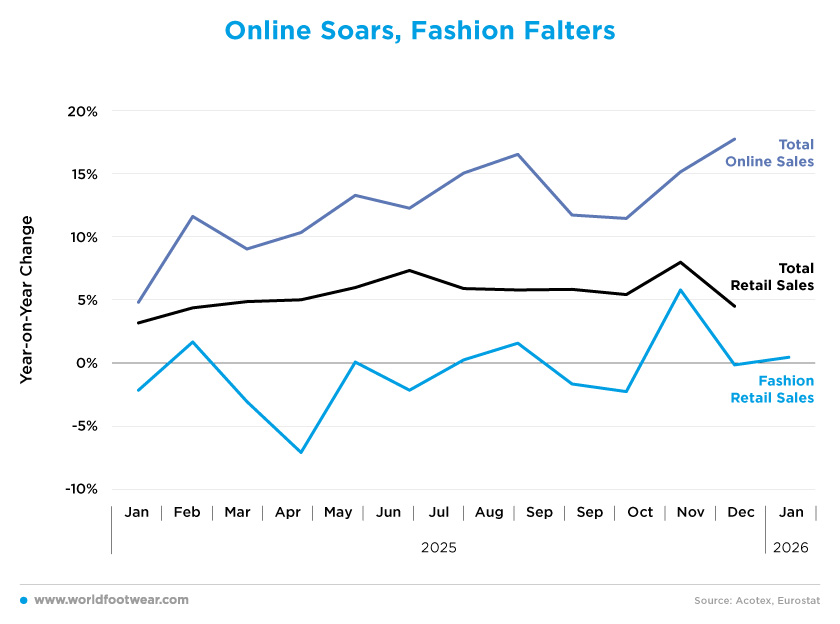
While the broader Spanish economy expanded by 2.8% in 2025 and total retail sales grew steadily, driven largely by double-digit gains in e-commerce, the fashion sector struggled. On average, there was a monthly year-on-year decline of 0.8% in clothing and footwear sales, accompanied by sector-specific deflation despite positive headline inflation. Although consumer confidence remained relatively solid, households increasingly prioritised services and savings over fashion purchases
Online Soars, Fashion Falters
The Spanish economy concluded 2025 with an estimated growth of 2.8%, significantly outperforming its major European counterparts (reuters.com). However, this broader macroeconomic strength did not translate into the fashion sector, where retail sales recorded an average monthly year-on-year decline of 0.8% compared with 2024.The year ended with a disappointing Christmas campaign, falling short of expectations. The trade association Acotex noted that “the sector still hasn’t managed to recover sales in a consistent way,” describing 2025 as a complicated year (revistadelcalzado.com). In December alone, sales contracted by 0.2% year-on-year.
The start of 2026 has remained subdued, with fashion sales increasing by just 0.4% in January – well below industry expectations. According to Acotex, consumers are allocating a greater share of their disposable income to services such as travel, dining out, and leisure activities, rather than buying clothing (revistadelcalzado.com).
In contrast, total retail sales continued to expand robustly throughout 2025, growing at an average monthly year-on-year rate of 5.4%. Digital channels remained the primary growth driver, with online retail sales increasing by an average of 12.3% year-on-year per month and peaking at 17.6% in December. While most distribution channels recorded negative growth rates in December, e-commerce was the clear exception (modaes.com).
Despite the weak performance of the broader fashion sector, leading firms such as Inditex demonstrated resilience. The group reported sales growth of 2.7%, reaching 28.2 billion euros in the first nine months of 2025, supported by solid performance across both physical stores and online platforms (inditex.com).
Inflation Overall, Deflation in Fashion
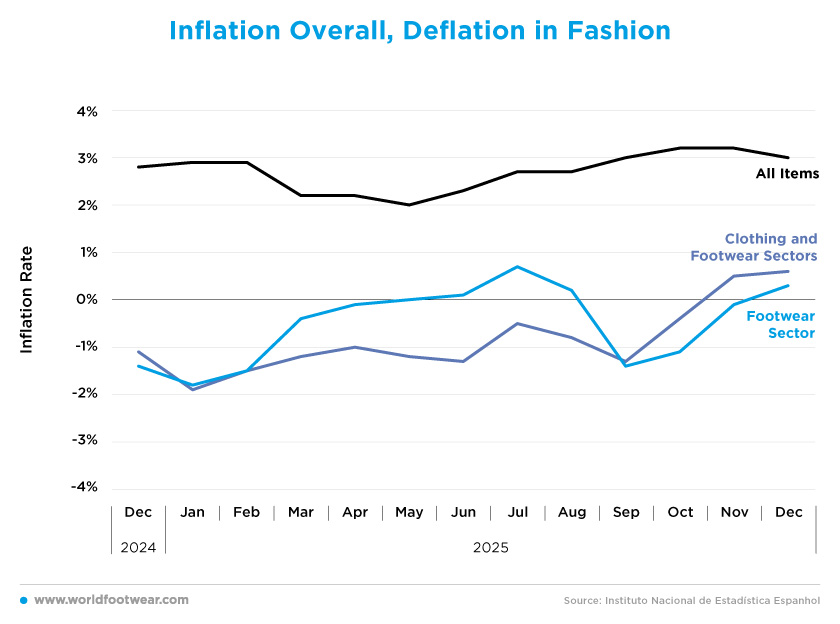
While Spain’s average inflation rate stood at 2.7% in 2025, the fashion sector experienced a clear deflationary trend. Over the course of the year clothing and footwear prices declined by 0.8%, while footwear alone fell by 0.4%. This contrasts sharply with the evolution of the overall consumer price index, resulting in a 2.9 percentage point gap relative to headline inflation. The data suggest that it remains difficult to pass on costs increases to final consumers (modaes.com).This divergence intensified at the start of 2026. In January, fashion prices fell by 13.1% month-on-month, marking the steepest January decline since the pandemic and the largest monthly drop among all components of the CPI basket. On a year-on-year basis, fashion prices decreased by 1.9% in January 2026, while headline inflation remained positive at 2.3% (moades.com).
A closer examination reveals internal disparities within the sector. Women’s footwear recorded the sharpest price adjustment, declining by 1.4% in January 2026, whereas men’s footwear registered a modest increase of 0.3% over the same period (revistadelcalzado.com). The coexistence of positive headline inflation and sector-specific deflation suggests either a relative reallocation of household spending away from fashion, or increasing pressure on firms’ margins, particularly given still-elevated supply chain costs (modaes.com).
High Confidence, Heavy Shipments
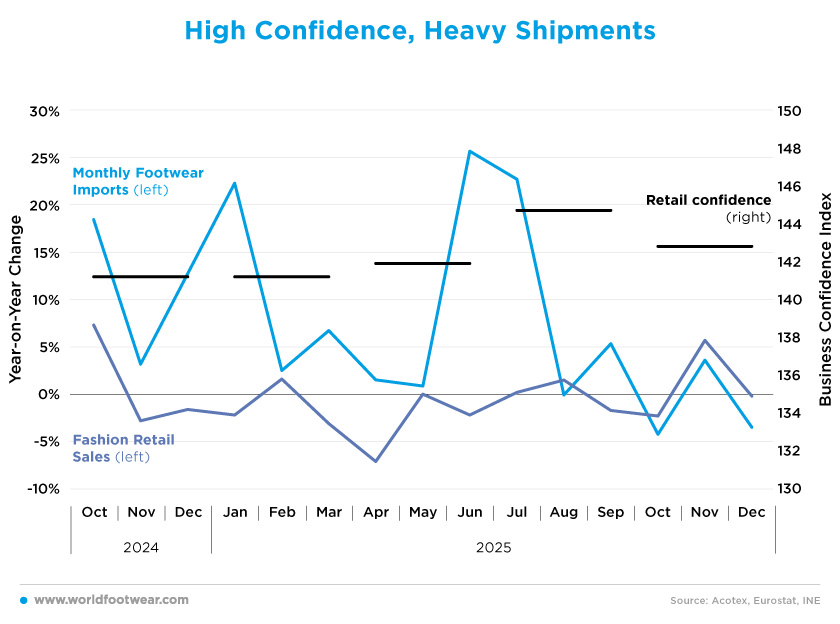
Spain’s macroeconomic momentum remained robust in 2025, with its National Statistics Institute estimating GDP growth at 2.8%. This strength was also evident the financial sector: consumer lending reached its highest monthly level since 2007 in October 2025, supported by a solid labour market and a record population approaching 50 million (reuters.com).Consumer confidence appears to be stabilising. According to the Kantar Panorama 4Q 2025 report, perceptions of the economic situation among households improved to 34 points, suggesting a more stable environment. Nevertheless, caution remains evident: 38% of consumers expect unemployment to rise, and saving continues to be a priority for households (modaes.com).
Similarly, Spain’s National Statistics Institute retail index shows a stable and positive trend, improving steadily since the final quarter of 2024 and peaking in the third quarter of 2025. It then reduces slightly, but still above the value in the second quarter of 2025.
However, despite relatively high levels of confidence, the fashion retail segment continues to face significant pressure, as this analysis has highlighted. Consumption in the sector remains subdued, with spending preferences shifting towards other goods and services, contributing to slightly negative price dynamics.
Interestingly, footwear imports have increased markedly, recording an average monthly year-on-year growth rate of 7% in 2025, despite losing pace towards the end of the year. This may reflect strengthened trading activity, as Spanish firms import footwear for subsequent re-export, thereby reducing their reliance on domestic demand.