


Footwear industry looks to technology and innovation to shape its future
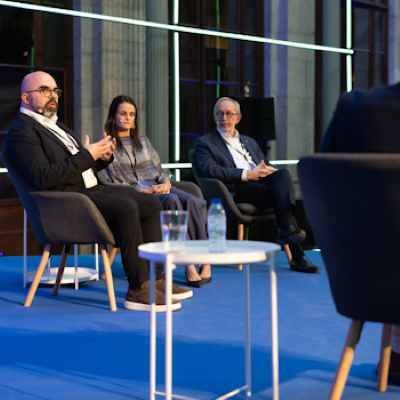
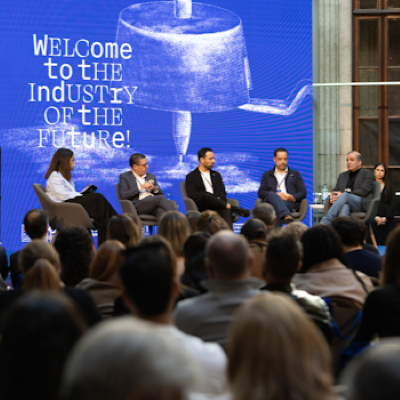
Innovation and technology were at the centre of a discussion on the future of the footwear industry. The speakers of an international conference held under the FAIST Agenda addressed issues such as production shifts, adoption barriers, and workforce transformation
As part of an international conference* held under the FAIST Agenda on the 18th and 19th of November to address the future of the Portuguese and European footwear industries, a panel, moderated by Luís Moura, brought together Carrie Howles from What the Future, Cristiano Figueiredo from CTCP and Sergio Dulio from UTTIC to discuss international perspectives on innovation and technology.
Setting the broader context for the debate, Sergio Dulio pointed to the current structure of global footwear manufacturing, noting that “we live in a very polarised world, because there is a massive production complex organised in one part of the world, while in another part you see the opposite”. He also mentioned that there are signs of a change in production location, albeit not on the same scale as a few years ago. In this sense, he does not foresee much room for major expansion in terms of volume in the future, but rather consolidation and diversification of business through innovation and the adoption of new technologies.
At company level, however, Cristiano Figueiredo said that one of the main difficulties for Portuguese footwear manufacturers face when adapting to and adopting new technologies and innovations is the cost. This is why projects such as FAIST are so important, “as they bring companies together to achieve results and make technology more affordable”. He also points to internal challenges, such as deciding which processes to automate, and ensuring that they have the necessary skills and capacity to implement new technologies.
Nonetheless, Carrie Howles believes that incorporating technology into footwear production is highly beneficial. To support this, she used the example of 3D-printed footwear, which is generating a lot of enthusiasm among younger generations because they don’t feel the need to perform certain tasks. Thus, “this technology is designed to manufacture shoes differently, prompting us to critically analyse our processes and look for ways to minimise the impact on workers”.
Cristiano shares this view and argues that “incorporating robotics and automation to optimise certain operations improves both production and people’s well-being”. However, he acknowledges that, currently, 3D printing and digital prototyping lack touch and smell, among other aspects. Nevertheless, they help reduce the number of samples and material consumption and facilitate changes to the original design.
In this context, there is room for both new and traditional products, and smaller companies can adapt to change more easily than larger ones. According to Cristiano, “technology plays a key role when we talk about smaller numbers with big results”, meaning that eliminating all waste is necessary.
Sergio Dulio lists two possible approaches to technology adoption: incremental or disruptive innovation. In fact, there are three different types of attitudes or behaviours that companies adopt: “Convinced adopters are companies that are very open to innovation. Cautious observers are companies that observe what is happening in the field of innovation and new technologies, but do not adopt or adapt to them quickly. Early explorers are companies that observe what is happening and immediately incorporate these innovations into their processes”.
He also adds that knowledge sharing is essential, emphasising that innovation involves more than just adopting new technologies; it requires a change in the nature of the company and its business model, made possible by technology.
The position of the employee in this process is also crucial. It is not uncommon for workers who used to perform routine manufacturing tasks to now become robot operators. This is a form of retraining, not replacement. It is a modification of work, meaning it is a way of maintaining the workforce by changing roles. In conclusion, Cristiano believes that “we need to be aware that humans need to adapt to technology, but that technology should be designed with people at its core”.
* Promoted by APICCAPS (Portuguese Footwear, Components, Leather Goods Manufacturers’ Association) and CTCP (Portuguese Technological Footwear Centre), the event brought together representatives from industry, academia, and public institutions to discuss the main challenges and opportunities associated with digitisation, sustainability, and technological innovation in the Portuguese and European footwear industries.
More information about FAIST available on the project's website: HERE
Source and Image Credits: apiccaps.pt

Related news



Related Organizations

-

-

World Footwear Public Calendar
Click here to subscribe an updated version of the calendar displaying the footwear trade shows.
-

-

-

-

Media Partners
Media Partners
-

Shoes Report

Shoe Intelligence

UNIT Publishing House

MPA Style