


FAIST Voices: meet Tecmacal
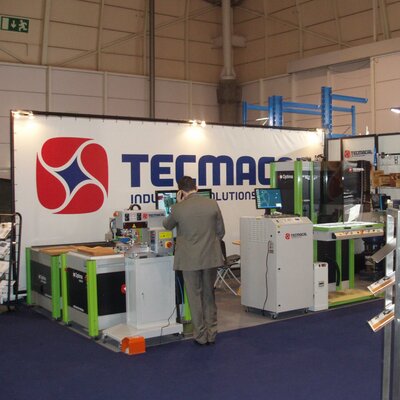
Part of the FAIST consortium, Tecmacal is developing new equipment solutions to improve automation, process control and added value in footwear manufacturing
The FAIST (Agile, Intelligent, Sustainable and Technological Factory) project is a consortium of more than 40 Portuguese partners, comprising footwear, components and leather goods manufacturers, technology developers and research institutions.
The project aims to modernise the Portuguese footwear industry by driving technological innovation and reinforcing international competitiveness, spanning from June 2022 to June 2026. Over the past four years, around 50 million euros in investment has been committed to the project.
Tecmacal
With close to 45 years of activity, Tecmacal has grown from a technical service business rooted in sewing-machine repair into a supplier and developer of industrial equipment for the footwear sector.
Based in São João da Madeira and with branches in Felgueiras and Benedita, the company built its reputation on machinery sales, technical assistance, after-sales support, and turnkey projects for footwear manufacturers.
Over time, its activity expanded beyond its original focus, with equipment installed across several industrial sectors and, with the acquisition of Gralin, the addition of metalworking capacity to support the production of industrial furniture and machine structures.
Ricardo Laranjeira, project manager at Tecmacal, has a long-standing family link to the company’s founders and described the firm’s evolution as the result of technical know-how, entrepreneurship and proximity to the needs of footwear manufacturers.
Under the FAIST
Within FAIST, Tecmacal is involved in developing two pieces of equipment. The first is a prototype immersion system for manufacturing footwear soles using a water-based polymer solution, with precise control of the immersion level to achieve the desired sole height.
Ricardo Laranjeira explained that the process involves placing the shoe, sandal or slipper on a last and immersing it in the material to a predefined level. The system then removes excess material and can repeat the operation to build the required sole.
The main challenge has been maintaining the stability of the immersion process in an industrial context. According to Laranjeira, what appears simple from the outside becomes much more complex in practice.
“Looking at the system, it seems very simple”, Laranjeira notes, but the material can dry or thicken during use, affecting the finish. In contrast, pumps, circulation systems and level sensors must be adapted to avoid blockages or loss of precision.
The project brings together Tecmacal, responsible for automation and equipment, Carité, as the footwear and leather goods partner, and the Portuguese Footwear Technological Centre (CTCP), which provides research and development support.
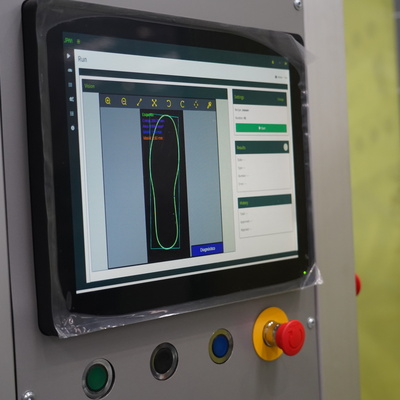
The second piece of equipment focuses on multi-material engraving for footwear and components. This equipment tests technologies such as induction, stamping and pad printing to identify the most suitable solution for different materials and applications.
Laranjeira describes this development as “a completely new process” that brings together two marking technologies. The aim is to respond to a limitation in the marking of insoles and components, particularly when colour is required.
As he explains, foil does not adhere well to many materials, while conventional pad printing can produce a flatter result. By combining hot marking and pad printing, Tecmacal aims to create a more distinctive finish, with both colour and low relief. In this case, Tecmacal works alongside Poleva, a footwear components partner, and CTCP.
One of the main technical challenges has been integrating both systems without moving the component, so that the relief and colour application remain aligned. According to Tecmacal, the main obstacles in both projects have largely been overcome, with the developments moving closer to production.
FAIST Outcomes
The expected outcomes are mainly linked to automation, process control and added value in footwear production.
The water-based polymer immersion system is intended to make sole formation more precise, repeatable and adaptable to the desired height, while reducing the uncertainty associated with a sensitive material process.
The multi-material engraving equipment, meanwhile, aims to improve marking quality across different components by combining relief and colour application in a single solution.
These projects also represent a broader step in the company’s path. The knowledge gained through FAIST will support future innovations in machinery, particularly in areas related to automation, sustainability and productivity.

Related news
Related Organizations

-

-

World Footwear Public Calendar
Click here to subscribe an updated version of the calendar displaying the footwear trade shows.
-

-
-

-

Media Partners
Media Partners
-

Fotoshoe

SHOES-MAGAZINE.COM

Schuhkurier

Shoe Intelligence