


Future of the footwear industry discussed at Porto conference
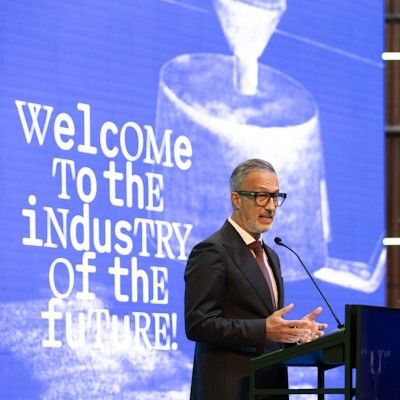
An international conference dedicated to the future of the Portuguese and European footwear industries was held as part of the FAIST project on the 18th and 19th of November
An international conference was held on the 18th and 19th of November, at the Palácio da Bolsa in Porto, as part of the FAIST Agenda – Agile, Intelligent, Sustainable, and Technological Factory. Promoted by APICCAPS (Portuguese Footwear, Components, Leather Goods Manufacturers’ Association) and CTCP (Portuguese Technological Footwear Centre), the event brought together representatives from industry, academia, and public institutions to discuss the main challenges and opportunities associated with digitisation, sustainability, and technological innovation in the Portuguese and European footwear industries.
In his opening speech, Luís Onofre, president of APICCAPS, stated that the FAIST project aims to make the Portuguese footwear industry “one of the most modern in the world” with an investment of more than 50 million euros in the areas of robotics, automation, and sustainability as part of the PRR plan.
The president also believes that “the concentration of 90% of footwear production in Asia is not sustainable from environmental, social or economic perspectives”, and that this makes the sector “unequal, especially by ignoring Europe’s potential”. Luís Onofre is certain: “Europe cannot settle for a secondary role. On the contrary, it must assert itself as a benchmark for quality, innovation and responsibility for the good of our planet”.
Sofia Moreira de Sousa, the European Commission’s representative in Portugal, also praised the Portuguese footwear industry, stating that it is “a clear example of how strategic anticipation and the ability to adapt can turn challenges into competitive advantages”. In her view, “the compass for competitiveness points towards strengthening strategic value chains, investing in innovation, accelerating the green transition, attracting and training talent, and supporting sectors capable of leading by example”.
Against this backdrop, the European Commission launched the Clean Industry Deal (CID) this year, a political and economic commitment aimed at bolstering European industrial competitiveness, accelerating the green and digital transition, and ensuring that Europe remains a hub for innovation, production, and technology. At the same time, the Commission is working to approve a simpler, more coherent and more business-friendly regulatory framework.
For the representative, “competitiveness must be based on Made in Europe” and, in this sense, “Portuguese footwear proves that innovation can be sustainable, tradition can be modern, and the industry can be human, competitive and global simultaneously”, making it “not only a national success, but a true European example”.
During the closing session, Rosana Perán, the president of the European Footwear Confederation (CEC), emphasised that “Portuguese footwear has made significant progress through the FAIST project by combining craftsmanship with robotics, automation, and artificial intelligence to create new value, while maintaining its traditional roots”. She added that “Portuguese companies have shown that innovation based on skill can redefine competitiveness”, since “artificial intelligence must be used responsibly with human talent at its core”.
Rosana Perán believes that, “in order for the EU to achieve a framework of competitiveness and growth, it is necessary to ensure a level playing field worldwide, limit access to online platforms selling products that do not comply with European regulations, and promote both sustainable consumption and the added value of EU-manufactured footwear (through the European Digital Passport and eco-design) to markets”.
The conference aimed to bring together all those who believe that the future of the footwear industry lies in combining technology, talent, and tradition. The programme included thematic sessions, panel discussions and technical visits to leading companies in the footwear and components sectors, providing a privileged space for knowledge sharing, networking and direct contact with innovative industrial solutions.
More information about FAIST is available on the project's website: HERE
Source and Image Credits: apiccaps.pt


Related news




Related Organizations

-
-

World Footwear Public Calendar
Click here to subscribe an updated version of the calendar displaying the footwear trade shows.
-

-

-

-
Media Partners
Media Partners
-

SERMA

MPA Style

La Conceria

Fotoshoe