


EU–Mercosur: What Does the Agreement Mean for the Footwear Industry?

The EU–Mercosur trade agreement is now in effect. A new World Footwear study examines the implications of the agreement for companies in the footwear, components, leather goods, and hides and leather sectors
After more than 25 years of negotiations, the EU–Mercosur Interim Trade Agreement came into provisional application on the 1st of May 2026. Connecting two regions with more than 700 million consumers, it sets out a gradual reduction of barriers to trade. For the footwear industry, its significance becomes clearer when the size of the combined economies is considered alongside the relatively modest trade flows between the two regions.
Drawing on data from a recent World Footwear study, we examine what the agreement could mean for the footwear industry in Europe and the United States.
Large markets, limited bilateral trade
Argentina, Brazil, Paraguay and Uruguay consumed around one billion pairs of shoes in 2024, making Mercosur the world’s fourth-largest footwear consumer market. Brazil accounted for approximately 85% of that demand. Yet the four countries imported only about 80 million pairs. In other words, the size of the consumer market has not translated into a comparably large market for imported footwear.On the other hand, the European Union (EU), considered as a single market, consumed 2.069 billion pairs of shoes in 2024 – more than twice Mercosur’s total. The EU also plays a much larger role in the global footwear trade, with six of its Member States ranking among the world’s ten largest footwear importers by volume.
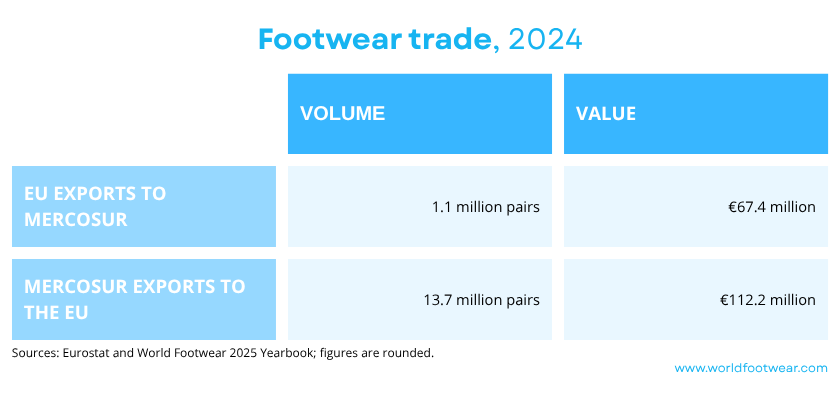
Trade between these two blocs highlights this contrast. EU footwear accounted for just 1.4% of Mercosur’s footwear imports by volume, but approximately 6% by value. This difference suggests a stronger presence in higher-value segments, even as the overall volume of exports remains small. Mercosur footwear, in turn, represented approximately 0.4% of the EU’s footwear imports by volume and 0.2% by value. Neither side is currently a major footwear supplier to the other.
Different tariff starting points
Before the agreement, the two markets had significantly different levels of tariff protection. According to World Footwear’s estimates, higher tariff rates were applied to goods entering Mercosur across all four product groups analysed: footwear, footwear components, leather goods, and hides and leather. The largest gaps were found in footwear, components and leather goods, while the difference for hides and leather was smaller.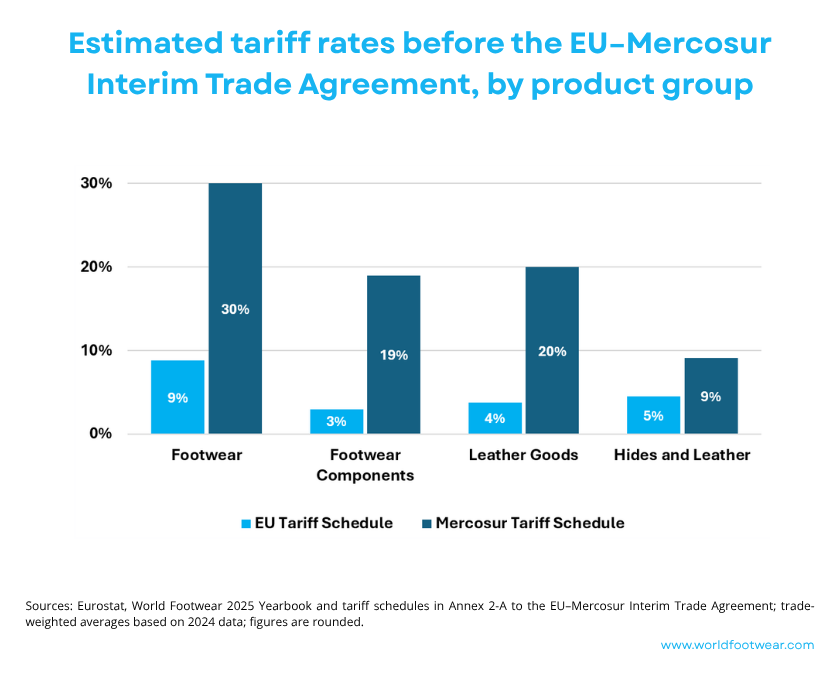 These figures describe the broad starting point for bilateral trade. They are estimates based on tariff schedules and trade values, rather than an actual record of duties paid by individual companies. The tariff applicable to a particular shipment depends on its precise classification, destination, and the applicable rate at the time.
What changes under the agreement?
The answer varies sharply depending on the product and the direction of trade. The Interim Trade Agreement reduces certain duties immediately, phases out others over several years and leaves certain tariff lines outside liberalisation. The following overview shows the general pattern for the footwear cluster.The schedules point to an uneven opening. For EU companies seeking customers in Mercosur, the agreement offers gradual improvements for certain products, but substantial parts of the footwear and leather-goods trade will remain subject to existing duties. For goods travelling in the opposite direction, EU tariff reductions are generally broader and faster. Depending on their products and position in the value chain, the implications for companies may therefore involve export opportunities, sourcing decisions and changing competitive conditions.
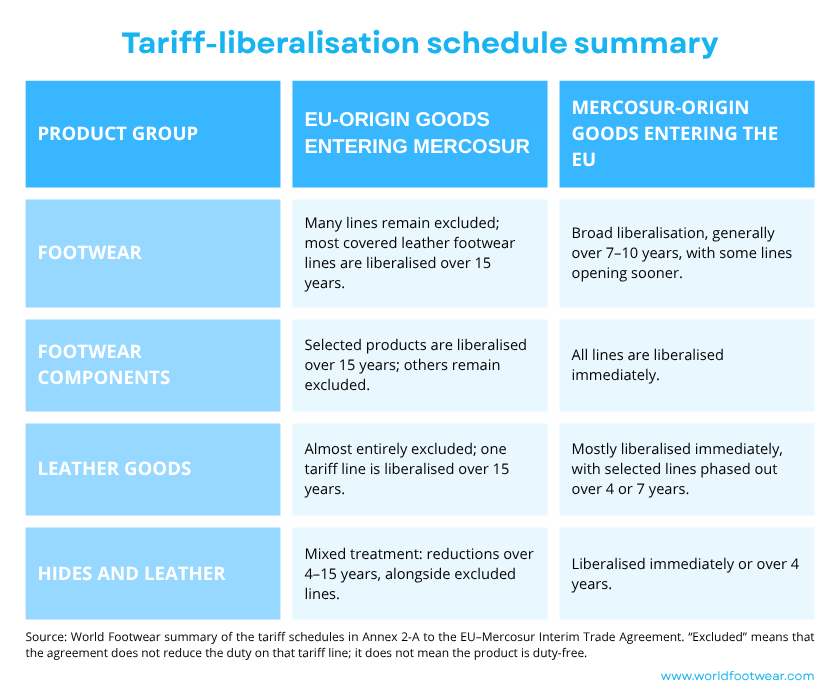
For a full account of the tariff-liberasalition schedule, consult our report on EU–Mercosur trade agreement.
Preferential tariffs are not automatic
Even when the agreement reduces a tariff, the lower rate does not apply automatically to every shipment. Goods must qualify as originating under the agreement’s rules, the exporter must provide the necessary proof of origin, and the importer must claim preferential treatment. Goods merely shipped from the EU or Mercosur do not necessarily qualify.Companies should therefore check both the tariff schedule and the conditions for using it before factoring in potential savings when setting prices or drawing up contracts. The tariff schedule shows the potential reduction; and meeting those conditions determines whether a company can use it.
To help companies examine those distinctions, World Footwear has carried out a comprehensive study of the agreement from the perspective of the footwear cluster. The resulting guide brings together market context, tariff commitments, and the relevant conditions for using them. It is intended as a practical reference tool for company owners, exporters, and importers to help them asses what the agreement could mean for their business.
Related news


-
-

World Footwear Public Calendar
Click here to subscribe an updated version of the calendar displaying the footwear trade shows.
-
-

-
Media Partners
Media Partners
-

Fotoshoe

Schuhkurier

La Conceria

Shoes Report